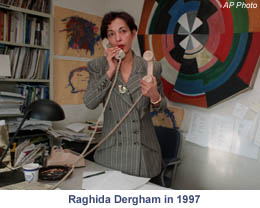
June 5, 2001 — CPJ today condemned the military trial of a New York-based Lebanese reporter who has been charged with “dealing with the enemy” because she participated in the same panel discussion as an Israeli official.
Raghida Dergham, the New York bureau chief for the London-based daily Al-Hayat and a noted commentator on Arab affairs, is being tried in a Lebanese military court. A warrant is currently out for the Lebanese-American citizen’s arrest, and she has been declared a fugitive. She did not appear at the first trial hearing in Beirut on June 1.
The charges against Dergham stem from her participation in a May 19, 2000, panel discussion sponsored by the Washington Institute for Near East Policy in Washington, D.C. The panel included Uri Lubrani, formerly the Israeli government’s coordinator of activities in southern Lebanon. The discussion focused on Middle East politics, with special reference to Syria, Lebanon and Israel.
CPJ has learned that the military indictment accused Dergham of being “a participant as a journalist in a debate that was arranged by a member of the enemy at the Washington Institute for Near Eastern Policy.” It added that “her act constituted a crime based on Article 278 of the Penal Code.”
At the June 1 session, the military court adjourned until November 30 in order to give Dergham the opportunity to appear before the court, Agence France-Presse reported. CPJ’s sources argue that the ongoing harassment of Dergham, including these latest charges, is a response to her critical coverage last year of Lebanon’s ongoing dispute with the U.N. over the demarcation of the Lebanese-Israeli border.
“These charges are absurd,” said CPJ Middle East program coordinator Joel Campagna. “We view the treason case against Dergham as part of a pattern of state harassment intended to punish an independent journalist for doing her job. The government of Lebanon has shown contempt for press freedom and the free public debate that is essential in a democratic society. The charges should be dropped, and Dergham should be free to work without further harassment.”
On June 19, 2000, one month after the Washington panel, Lebanese authorities seized Dergham’s Lebanese passport when she arrived at Beirut Airport with United Nations Secretary General Kofi Annan, who was on a tour of several Middle East countries. When the passport was returned before her scheduled departure the following day, it had been cancelled. The cancellation stamp stated specifically that the passport could not be renewed without the approval of the General Directorate for Internal Security.
Security officials gave no reason for their actions at the time, but later announced that Derghan had violated Lebanese law prohibiting contacts between Lebanese citizens and Israelis.
CPJ protested the harassment of Dergham in a July 7 letter to Lebanese president Emile Lahoud. Later that month, Lebanon’s ambassador to the U.N. informed Secretary General Annan’s office that President Lahoud had reversed the cancellation of Dergham’s passport. But Lebanese officials recently refused to grant Dergham a new passport on the grounds that the ban was still in effect.
END