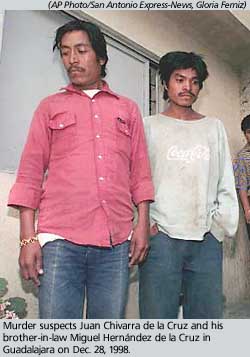
New York, August 9, 2001—On August 3, a Mexican judge acquitted the two men accused in the 1998 murder of American journalist Philip True.
Juan Chivarra de la Cruz and his brother-in-law Miguel Hernández de la Cruz were charged with True’s murder in December 1998. Municipal Judge José Luis Reyes Contreras ordered their release despite a preponderance of evidence implicating the two men.
“We believe that the two men in custody were involved in some capacity,” said CPJ deputy director Joel Simon. “When the investigation into True’s death began, CPJ urged Mexican authorities to conduct an exemplary investigation and prosecution so as not to leave any doubt regarding the culpability or innocence of those charged. That has certainly not happened.”
Yesterday, the attorney general of Jalisco State said there was enough evidence to convict the two men and added that he would appeal the verdict, according to the Texas daily San Antonio Express-News, True’s former paper.
Death in the mountains
True, 50, was a Mexico City correspondent for the San Antonio Express-News. On November 28, 1998, he embarked on a 10-day trip to report on the Huichol Indians, an indigenous population that lives in a mountainous area stretching across Nayarit, Jalisco, and Durango states.
The journalist was last seen alive on December 4 in the village of Chalmotitia. On December 16, after an intensive search by the Mexican military, True’s body was found in a shallow grave partially covered with rocks at the bottom of a ravine. Neither his wedding ring nor his watch had been taken, suggesting that robbery was not a motive.
On December 26, 1998, authorities arrested Chivarra and Hernández, both Huichol Indians, who confessed to murdering True because he had taken photographs without their permission. The journalist’s belongings, including his camera, binoculars, and backpack, were found at the suspects’ homes.
When the two men were brought into court, however, they acknowledged killing True but claimed they had acted in self-defense. They also claimed that their confession had been extracted under torture. Jalisco State attorney general Gerardo Octavio Solís Gómez denied that in his statement yesterday.
Additional evidence points to the suspects’ culpability. In 1999, a Newsweek reporter found a notebook belonging to True in a warehouse where case evidence was stored. In one entry, True described an encounter with a Huichol man named Juan, possibly a reference to Chivarra.
Both suspects have repeatedly given contradictory statements in interviews with the San Antonio Express-News. While they initially contended that they had never seen True, they later admitted to meeting him. Then in an interview published on August 8, 2001, both men claimed they had seen the journalist but never talked to him.
Dueling autopsies
Mexican authorities have issued three separate forensic reports since True’s body was found. The first, based on an autopsy by Jalisco State medical examiners, found that True had been strangled with his own bandana and sustained a head injury that was not attributable to a fall.
The second report, based on an autopsy by the Federal Attorney General’s Office, concluded that True died from blows to his head and body and from edema (accumulation of fluid in the lungs), most likely after suffering an accidental fall caused by heavy drinking.
Both autopsies found a high concentration of alcohol in True’s blood, a finding consistent with advanced decomposition, according to forensic experts consulted by the Express-News.
In March 2000, the third forensic report, which is required under Mexican law when two autopsies yield different results, found that True’s death was caused by a pulmonary edema resulting from a head injury. This conclusion was based solely on the examiner’s analysis of the first two autopsy reports.
Judge Reyes Contreras was quoted as saying that his decision to release the men was based on the second autopsy report, which concluded that True’s death was accidental.
The judge’s ruling did not account for the fact that True’s belongings were found in the two suspects’ homes or that his body was hidden in a grave near the death site.
On December 17, 1998, CPJ sent a letter to President Ernesto Zedillo Ponce de León, urging that federal authorities conduct a thorough investigation into True’s murder.
