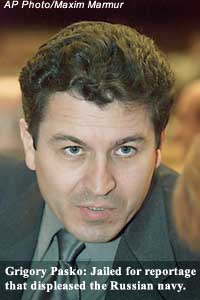
New York, December 25, 2001—The Committee to Protect Journalists (CPJ) is outraged by the prison sentence handed down today to journalist Grigory Pasko by the Military Court of the Pacific Fleet in Vladivostok.
The court found Pasko guilty of treason and sentenced him to four years in prison, according to local news reports and CPJ sources. Russian prosecutors had demanded a nine-year sentence.
The ruling also stripped Pasko of his military rank and state decorations, Russian news agency Interfax reported. The journalist was taken into custody in court and placed in detention, Sergey Ivaschenko, a member of the Vladivostok Committee for the Defense of Pasko, told CPJ.
“Today’s ruling demonstrates that the trial of Grigory Pasko was nothing more than a political vendetta against a journalist who made public information that embarrassed the Russian military but served the public,” said CPJ deputy director Joel Simon.
“Pasko’s detention is a black mark on the Russian justice system.”
Pasko’s attorney Anatoly Pyshkin has already filed an appeal with the Military Collegium of the Russian Supreme Court seeking full acquittal, Ivaschenko told CPJ.
Background
Pasko, an investigative reporter with Boyevaya Vakhta (Battle Watch), a newspaper published by the Pacific Fleet, was arrested in November 1997 and charged with passing classified documents to Japanese news outlets. He spent 20 months in prison while awaiting trial.
In July 1999, he was acquitted of treason but found guilty of abusing his authority as an officer. He was immediately amnestied, but four months later the Military Collegium of the Russian Supreme Court canceled the Vladivostok court’s verdict and ordered a new trial.
Pasko’s new trial began on July 11 after having been postponed three times since March.
During the trial, Pasko’s defense demonstrated that the proceedings lacked a basis in Russian law. Article 7 of the Federal Law on State Secrets, which stipulates that information about environmental dangers cannot be classified, protects Pasko’s work on sensitive issues, such as radioactive pollution. The prosecution is relied on a secret Military of Defense decree (No. 055) even though the Russian Constitution bars the use of secret legislation in criminal cases.
The defense also challenged the veracity of many of the witnesses, several of whom acknowledged that the Federal Security Service (FSB) falsified their statements or tried to persuade them to give false testimony. An FSB investigator had been reprimanded for falsifying evidence in the first trial, and the signatures of two people who witnessed a search of the reporter’s apartment were forged.
“The legal basis for the trial was questionable, the evidence was faulty, and in the end Pasko was convicted after being tried twice on the same charges, making him the clear victim of double jeopardy,” noted CPJ Europe program coordinator Alex Lupis. “The Military Collegium should immediately recognize the absurdity of today’s verdict and overturn the lower court’s ruling. Pasko’s detention is a black mark on the Russian justice system and further undermines President Putin’s stated commitment to press freedom.”
END