New York, June 27, 2001 — A CPJ delegation led by board member Peter Arnett met today with Russian ambassador Yuri Ushakov in Washington, DC, to express its deep concern about the forthcoming trial of military journalist Grigory Pasko in Vladivostok.
Russian military authorities have been pursuing Pasko for nearly four years on charges of espionage and revealing state secrets. Authorities claim that in 1997, Pasko leaked classified information about the Russian Fleet’s dumping of nuclear waste in the Sea of Japan to a Japanese television station.
Press freedom test case
“Of the many press freedom violations CPJ has documented in Russia, the continued prosecution of Pasko, simply for exposing the illegal dumping of nuclear waste, is a test case of the positive intentions of the Russian government,” Arnett told Ambassador Ushakov during the meeting.
The Ambassador disagreed with CPJ’s assessment of press freedom conditions in Russia, but promised to relay CPJ concerns about specific cases to government authorities in Moscow.
Also attending today’s meeting at the Russian Embassy were CPJ Europe and Central Asia program coordinator Alex Lupis and Washington representative Frank Smyth.
Trial begins July 11
Pasko’s second trial is currently set to begin on July 11, after three postponements in recent months. Defense lawyer Anatoly Pyshkin has characterized the delays as an attempt by Pacific Fleet prosecutors “to erode the stamina and resources of Pasko’s supporters.”
A CPJ delegation visited Vladivostok in early June to observe the trial. After the first postponement was announced, CPJ board member Peter Arnett and Europe program consultant Emma Gray held a press conference in Vladivostok to protest the delay and support Pasko.
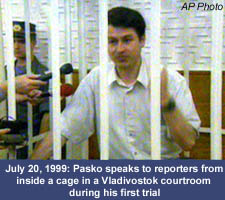
Pasko was an investigative reporter with Boyevaya Vakhta, a newspaper published by the Russian Pacific Fleet. He was arrested on November 20, 1997, and accused of passing classified documents to the Japanese television network NHK. Pasko maintained that he passed no classified material, and that he was prosecuted for working with Japanese news outlets that publicized environmental hazards at the Pacific Fleet’s facilities. The journalist spent 20 months in prison awaiting trial. On July 20, 1999, he was acquitted of treason, but found guilty of abusing his authority as an officer. He received a three-year sentence but was released under an amnesty program. His ordeal did not end there, however. On November 21, 2000, the Military Collegium of the Russian Supreme Court cancelled the lower court’s verdict and called for new hearings. Pasko faces a sentence of 12 to 20 years in prison if convicted.
END
END