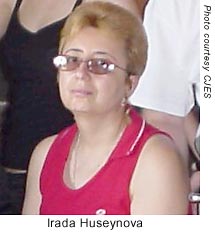
New York, July 1, 2004—Bowing to international pressure, the mayor of Azerbaijan’s capital, Baku, has dropped criminal charges against a journalist who had criticized his administration. The Committee to Protect Journalists (CPJ) welcomes the decision, but calls on the government to scrap its criminal defamation law entirely.
The Nizami District Court closed the criminal case against Irada Huseynova on June 24, a day after the plaintiff, Baku Mayor Hajibala Abutalibov, officially dropped charges against her, a mediator involved in the case told CPJ.
“I’m happy that the criminal case is behind me now,” Huseynova told CPJ in a telephone interview. “I’m relieved to have freedom of movement again.”
CPJ had advocated on behalf of Huseynova, who is now living and working in Moscow. In a June 2 letter to Azerbaijani President Ilham Aliyev, CPJ urged the government to drop the charges before a mid-June meeting of free expression groups in Baku. CPJ also called on the government to decriminalize libel. [Read CPJ’s letter.]
Huseynova had been invited to the June 14-18 meeting of the International Freedom of Expression Exchange (IFEX) in Baku, but she could not attend because she faced arrest upon return to Azerbaijan. On the final day of the IFEX meeting, CPJ highlighted Huseynova’s case in a press conference that called on the government to end repression of independent media.
Ibrahim Mamedly, coordinator of the Permanent Commission at the Press Council, an organization that mediates conflicts between the Azerbaijani government and the media, said he met with Abutalibov on June 21 to discuss Huseynova’s case. Citing the growing international concern about the journalist, Mamedly called on Abutalibov to drop the charges against her. Two days later, Mamedly said, Abutalibov filed an official statement dropping the charges at the Nizami District Court.
“We welcome this decision by Mayor Abutalibov,” said CPJ Executive Director Ann Cooper. “We call on the government to take the next step by repealing its criminal defamation law.”
Background
Huseynova’s prosecution stemmed from a June 2001 article for the independent Baku weekly Bakinsky Bulvar that criticized Abutalibov for closing important tram lines in Baku, building water fountains in Baku during a water shortage, and demolishing commercial kiosks, a move that left many unemployed.
Huseynova, along with Bakinsky Bulvar founder Elmar Huseynov and Editor-in-Chief Bella Zakirova, were convicted of civil defamation and fined in September 2001. That same month, Bakinsky Bulvar was closed, and Huseynova left Azerbaijan to attend a conference in Poland. While she was in Poland, an Azerbaijani court launched criminal defamation proceedings against Huseynova and her colleagues, and Huseynova was put on an Azerbaijani government wanted list.
When the conference ended in late September, she traveled to Moscow, and a year later, she began working as an editor and later as an analyst for the Moscow-based Center for Journalism in Extreme Situations (CJES), a Russian press freedom organization.
Although Huseynova could not be tried while outside the country, her colleagues were convicted of criminal defamation in September 2001.
On November 25, 2002, Russian police arrested Huseynova at the request of Azerbaijani authorities, who wanted her extradited to face the defamation charges. CJES immediately issued a statement, and Huseynova was released after press freedom and human rights organizations protested.
The June 14-18 IFEX meeting brought together representatives of 57 free expression groups from around the world, all of which joined in CPJ’s lobbying efforts in support of Huseynova.
