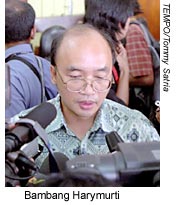
Jakarta, Sept. 7, 2004—Under intense scrutiny from the international media and press advocates from around the world, a court yesterday delayed its verdict in a criminal defamation case widely seen as a grave threat to press freedom in Indonesia.
No official reason was given for delaying a verdict in the trial of Tempo editor Bambang Harymurti, who faces 10 years in prison on charges of defamation and spreading false information that provoked social discord. The case has attracted intense international attention, and advocates showed up in force for yesterday’s hearing.
Led by the Committee to Protect Journalists and the Southeast Asian Press Alliance (SEAPA), a delegation of media advocates from Thailand, the Philippines, Malaysia, and Hong Kong decried the prosecution and expressed solidarity with their Indonesian counterparts. Free press advocates from Asia, Australia, Europe, and the United States called for Harymurti’s acquittal, and for the decriminalization of defamation in Indonesia.
More than 100 Indonesian and international journalists jammed the courtroom as the three-judge panel announced it would delay its verdict. The judges postponed the case to September 16, just four days before the presidential runoff. Two co-defendants—Tempo reporter Ahmad Taufik and editor Teuku Iskandar Ali—were already scheduled to appear in court again Sept. 16.
In a joint statement, CPJ and SEAPA expressed disappointment that Harymurti was not acquitted immediately, and said the case has broad implications that will be watched around the world.
“The charges against Harymurti and his colleagues are ultimately about the chilling effect that criminal defamation laws have on the press,” CPJ Executive Director Ann Cooper said. “The criminalization of libel and defamation is an outdated practice that is being rescinded in true democracies all over the world. In this light, the Indonesian courts should acquit Harymurti and set a precedent by which defamation in Indonesia will ultimately be decriminalized.”
The criminal case stems from a March 2003 article in Tempo citing allegations that businessman Tomy Winata may have stood to profit from a Jakarta textile market fire. Winata, who has denied any tie to the fire, filed several criminal and civil complaints against the Tempo journalists.
In a meeting with CPJ, SEAPA, and Indonesian supporters on Sunday, Harymurti said: “I want to remain hopeful and optimistic. We are hoping that this case could do for Indonesia what The New York Times vs. Sullivan did for free expression in the United States.”
SEAPA Executive Director Roby Alampay said journalists throughout Southeast Asia are closely monitoring the case, aware that its resolution could affect the handling of similar cases in their countries. In Thailand, for example, journalists are monitoring a criminal defamation case against activist Supinya Klangnarong. In a published article, Klangnarong said media giant Shin Corp., a company partly owned by the family of Prime Minister Thaksin Shinawatra, has benefited from the Thai leader’s term in office.
“Journalists from Thailand, the Philippines, and Malaysia have traveled to Indonesia to show their solidarity with their Indonesian colleagues and to stress that the free press cause knows no boundaries,” Alampay said.
Joining CPJ and SEAPA in their delegation to Jakarta were: Melinda Quintos de Jesus, executive director of the Center for Media Freedom and Responsibility; Teodoro Locsin Jr., member of the Philippine House of Representatives and publisher-on-leave of the Manila daily Today; Carlos Conde, secretary general of the National Union of Journalists of the Philippines; Kavi Chongkittavorn, associate group editor of The Nation; Veera Pratipchaikul, executive editor of Bangkok Post; and Steven Gan, editor of Kuala Lumpur’s leading alternative news outlet, Malaysiakini.
CPJ was represented by Lin Neumann, its former Asia program coordinator and now executive editor of the Hong Kong Standard.
