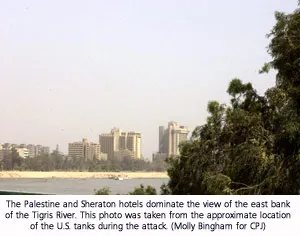
New York, November 5, 2004—Nineteen months after a U.S. Army tank opened fire on a Baghdad hotel full of journalists, killing two and wounding three others, the Pentagon has released a redacted report concluding that coalition forces bore “no fault or negligence” in the shelling. In August 2003, the Pentagon had released summary findings about its investigation into the incident but until now had kept the report classified.
The Committee to Protect Journalists, while welcoming the release of the U.S. Central Command inquiry into the April 8, 2003, attack on the Palestine Hotel, questioned its main findings and called on the Pentagon to follow through on earlier military recommendations intended to increase journalist security.
Reuters cameraman Taras Protsyuk and Spanish cameraman José Couso of Telecinco, were killed in the attack, which came during a day of intense combat in Baghdad. That day, CPJ called on Secretary of Defense Donald H. Rumsfeld “to launch an immediate and thorough investigation … and to make the findings public.”
CPJ’s own investigation, published in May 2003, concluded that the attack was not deliberate but was avoidable. In light of the Army’s report, CPJ reaffirms that position. CPJ’s investigation described an apparent communication breakdown within the U.S. Army chain of command, and questioned whether target information known to senior officers was disseminated to battle units. Pentagon officials and commanders in Baghdad had been widely aware that the Palestine Hotel was full of international journalists. About 100 journalists were lodged there at the time. The Army report leaves open the question of why troops were not made aware of the presence of journalists at the hotel.
The U.S. Central Command investigation, which includes interviews with platoon and company soldiers, was completed by June 5, 2003, but the Pentagon did not clear its release until September 2004. The 52-page report was released by mail from Fort McPherson, Ga., postmarked November 1, in response to a Freedom of Information Act request that CPJ filed in May 2003. (CPJ has not received a response to a FOIA request requesting information about the a U.S. missile strike on Al-Jazeera’s Baghdad office that same day, killing reporter Tareq Ayyoub. The Pentagon has said no investigation into the strike took place.)
Details of the Army report, focusing on the actions of the 3rd Infantry Division’s 4th Battalion 64th Armor Regiment, are mostly consistent with CPJ’s own investigation into the shelling, which concluded that after a morning of heavy fighting near the Tigris River the tank opened fire on what it believed was an Iraqi “spotter” directing enemy fire at U.S. troops from the hotel’s upper floors or roof. It appears from soldier testimony that troops likely mistook cameramen working on the hotel’s balconies for the “spotters.”
But there were “several spot reports” about different Iraqis directing Iraqi artillery strikes in the area at the time, according to the report’s investigating officer, whose name has been excised from the report. Intercepted Iraqi radio communications indicated that the only thing that soldiers of the 64th Armor Regiment were sure of is that the tanks near the Tigris River were “being observed from a ‘multi-story’ building; one high enough to be able to observe.”
The Army report, however, also reiterates previous claims of the military that soldiers were responding to hostile fire from the hotel. That finding is at odds with CPJ’s own investigation, which was based on interviews with about a dozen reporters at the scene. None of the journalists based inside the Palestine Hotel reported evidence of hostile fire coming from the hotel, CPJ’s investigation found.
The report also fails to address the question of why U.S. troops on the ground were not made aware that the Palestine Hotel—one of the best-known civilian sites in Baghdad at the time—was full of journalists. The testimony of at least one soldier cited in the Army report appears to indicate that U.S. troops were unaware of any sensitive civilian targets in their area of operations. “At no time was there any discussion of no-fire areas, or protected sites on the east side of the Tigris River,” the soldier, whose name was excised, wrote.
The Army report recommends that “non-embedded media personnel routinely inform, through the proper military and civilian authorities, their locations during combat operations.” However, the evidence suggests that news organizations did exactly that, and senior U.S. commanders were aware that the hotel was full of journalists—but apparently did not convey the information to troops on the ground.
The commanding lieutenant general in charge of the investigation, whose name has been excised from the report, concludes: “I have the deepest sympathy for the families of those who were killed. However, responsibility for the incident rests with an enemy that chose to fight in a city, needlessly exposing the civilian population, including journalists, to the hazards of war.”
In a previous U.S. Army report, one by the 3rd Armored Cavalry Regiment based in Fort Carson, Colorado, into the August 17, 2003, fatal shooting of Reuters cameraman (and CPJ International Press Freedom Award winner) Mazen Dana, the 3rd Cavalry report recommended that U.S. troops improve communication between the military and the media, and within the military itself regarding the presence of media on the battlefield. It also urged a review of the Army’s rules of engagement in order to avoid harming journalists in areas of combat.
CPJ is disappointed that this report about the shelling of the Palestine hotel—which took inexplicably long to be released—did not make the same recommendations.
Journalists in Iraq continue to come under fire.Thirty-six journalists have been killed in Iraq since the conflict began in March 2003. At least nine journalists were killed by fire from U.S. forces, the second highest cause of death behind insurgent actions, which led to the deaths of 19 journalists. The remainder died at the hands of Iraqi armed forces during the combat phase of the war, or in crossfire from unclear sources. [See complete statistics]
