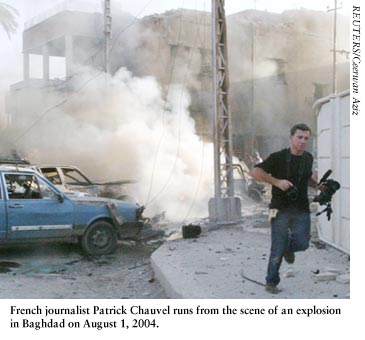
New York, October 19, 2004—The conflict in Iraq has become one the most dangerous for journalists in recent history, and Iraqi journalists are bearing an ever-greater burden, according to data released today by the Committee to Protect Journalists. Foreign correspondents continue to face a range of severe risks, with abductions by criminal and insurgent groups posing new peril this year. Overall, CPJ found, insurgent actions are the leading cause of journalist deaths in Iraq.
At least 35 journalists have been killed as a result of hostile actions since the U.S.-led war in Iraq began in March 2003, with 22 killed in 2004 alone. Iraqi journalists, 16 of whom died on duty this year, now comprise nearly half of the overall toll.
Conflicts in Algeria, Colombia, the Balkans, and the Philippines have resulted in similarly high rates of journalist deaths since CPJ was founded in 1981. In Algeria, at least 58 journalists were killed between 1993 and 1996, with 24 deaths coming in 1995 alone, according to CPJ data. In Colombia, 51 journalists have been killed since 1986. In the Balkans, 36 died on duty from 1991 to 1995. In the Philippines, 36 were killed between 1983 and 1987.
CPJ data reveal that the sources of danger for journalists in Iraq are varied. But of the 35 journalists killed, 19 died from insurgent actions ranging from gunfire to suicide bombings to targeted killings. At least eight journalists were killed by fire from U.S. forces, the second highest cause of death. The remainder died at the hands of Iraqi armed forces during the combat phase of the war, or in crossfire from unclear sources.
CPJ is investigating two other deaths to determine whether the victims were killed for their journalistic work. At least two journalists remain missing.
Media support workers—drivers, interpreters, and guides who are typically Iraqi citizens—also face growing danger for their work. Thirteen have been killed since hostilities began, but 11 of those deaths came in 2004.
The profile of the victims has also changed drastically since last year. Foreigners accounted for all but two of the deaths of journalists and media workers in 2003. In 2004, though, most of those killed were Iraqis: 16 of the 22 journalists, and all 11 of the media workers.
The demographic change illustrates that Iraqis are filling a growing need—and facing greater dangers—in their roles as local reporters and employees of international news organizations. The two most recent killings reflect the trend: Dina Mohammed Hassan, a reporter for Al-Hurriya television, and Karam Hussein, a photographer for the European Pressphoto Agency, were gunned down just hours apart last Thursday. Both were Iraqis, and both were victims of targeted killings in retaliation for their work.
Iraq is fraught with different risks: Banditry, gunfire, and bombings have been commonplace during the postwar period. But criminal and insurgent groups added a new threat this year by systematically targeting foreigners, including journalists, for abduction. At least 22 journalists have been kidnapped for extended periods in 2004. Nineteen were released, one was executed, and two remain captive.
“Security threats endanger all parties in Iraq, including civilians, and they severely limit journalists’ ability to cover the news. Travel, even on the streets of Baghdad, can be life-threatening,” CPJ Executive Director Ann Cooper said. “These statistics are a chilling reminder of the extraordinary dangers that journalists face in Iraq, and they demonstrate the evolving nature of the peril. Iraqis working for foreign media outlets, for example, are being threatened, attacked, and killed in greater numbers.
“Despite all these risks, many journalists and media workers continue their work to give the world vital, independent information about the conflict and its impact,” Cooper said.
See a breakdown of the statistics. The data will be updated regularly on CPJ’s Web site. Other resources and CPJ research on Iraq are also available.
