New York, November 15, 2004—The Committee to Protect Journalists strongly condemns the two fatal attacks on Philippine journalists over the weekend, the latest killings in an already record-breaking year for violence against the press in the Philippines.
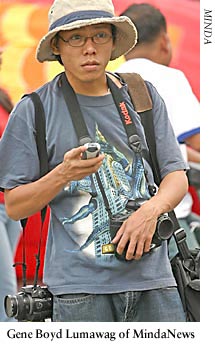
An unidentified gunman shot photographer Gene Boyd Lumawag, of the MindaNews news service, in the head, killing him instantly on Friday, November 12, in Jolo, the capital of the southern Sulu Province.
The next day, Bombo Radiyo station manager and commentator Herson Hinolan was shot in the stomach and arms by unknown assailants in Kalibo in the central Panay Island, according to international news reports and local sources. Hinolan died of his injuries today, local sources tell CPJ.
“This chilling epidemic of deadly attacks on Philippine journalists will only by stemmed by immediate and decisive action from local authorities,” said CPJ Executive Director Ann Cooper. “We are deeply outraged and saddened by the climbing numbers of deaths suffered by our colleagues in the Philippines, and we demand more than just lip service from the government. It is high time that officials made good on their promises to uphold press freedom by bringing those who murder journalists to justice.”
At dusk on November 12, Lumawag, went to the pier in Jolo to take a picture of the sunset on the last day of Ramadan in the Muslim-majority area when he was shot and killed by a single bullet wound to the head, according to local news accounts. Lumawag, 26, had traveled to Jolo with another reporter on November 10 to work on a video documentary about transparency and local governing practices for the U.S.-based Asia Foundation.
Sulu Province, comprising a group of islands 310 miles (500 kilometers) south of the capital, Manila, has a Muslim-majority population and is a bastion for the Islamic separatist group Abu Sayyaf, The Associated Press reported. Abu Sayyaf has been linked to the international terrorist group al-Qaeda and has made headlines in recent years with high-profile kidnappings for ransom. The island province is also a stronghold for Jemaah Islamiah, another militant Islamic separatist group suspected of masterminding the 2002 Bali bombing that is linked to Abu Sayyaf, according to local sources.
The motive for Lumawag’s murder was unclear, and local police and army spokesmen put forward different theories. Army investigators told Mindanews chairwoman Carolyn Arguillas, who had accompanied Lumawag, that they suspected Abu Sayyaf members were responsible for the killing. The head of the local antiterrorism unit, Brig. Gen. Agustin Dema-ala, also claimed in local news reports that the gunman’s description matched that of a wanted local Abu Sayyaf operative.
But in an interview with the Philippine Daily Inquirer, local police head, Chief Superintendent Vidal Querol, said that the corruption story the two journalists were pursuing was the likely motive. Local news accounts also speculated that Lumawag might have been mistaken as a spy or member of the military because the clothes he had on that day resembled fatigues, and the fact that he spoke Filipino instead of the local Tausig language.
Herson Hinolan, station manager and commentator from Bombo Radiyo in Kalibo in the central Aklan Province, was fatally injured Saturday night when he was shot in the abdomen and arms in the restroom of a local store, police told local reporters. Although no motive has been determined yet in the murder, Hinolan was known as a “hard-hitting commentator,” local Chief Superintendent George Alino told Agence France-Presse. In a statement, Bombo Radyo managers accused “assassins” of “killing the messenger who is tasked to serve the public by way of exposing the truth.” The station offered a reward for any information leading to the identification or capture of those responsible for Hinolan’s murder.
CPJ is investigating Hinolan’s death to determine if he was killed for his work as a journalist.
According to CPJ research, six other journalists have been killed in the line of duty in the Philippines so far this year, more than in any other country except Iraq. Forty-seven journalists have been murdered in the Philippines since the country became a democracy in 1986, and no one has been convicted in any of these cases.
