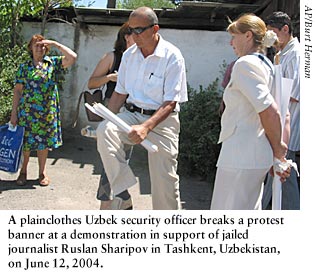
New York, October 26, 2004—Ruslan Sharipov, an independent journalist and human rights activist who was persecuted, tortured and imprisoned by Uzbek authorities, has resettled in California after gaining political refugee status in the United States.
In an interview with the Committee to Protect Journalists yesterday, Sharipov said he is excited to “taste freedom again” and thanked the numerous press and human rights organizations that supported him. Sharipov said he arrived in the United States on October 21 after spending the past four months in exile in Moscow. He traveled the next day to California, where he was reunited with his mother and brother.
“We’re glad that our colleague is finally safe, but we remain deeply concerned about other journalists whom Uzbek authorities have imprisoned in retaliation for their work,”
CPJ Executive Director Ann Cooper said.
Cooper called on President Islam Karimov to do “everything in his power” to see to the release of freelance journalist Gayrat Mehliboyev, and journalists Muhammad Bekjanov and Yusuf Ruzimuradov of the opposition newspaper Erk. She also urged “an independent and impartial review of the charges and evidence against them.”
The Uzbek police and security service harassed Sharipov for several years because of his articles on police abuses and press freedom violations, which were written for the Russian news agency Prima and the Web site of the Union of Independent Journalists in Uzbekistan. Many of Sharipov’s articles were published in English, making them accessible to an international audience.
Uzbek authorities stepped up their attacks in 2003, when Sharipov was convicted on criminal charges of sodomy, having sex with minors, and managing prostitutes. Sharipov, who is openly gay, denied the accusations and said that authorities tortured him to get a confession. He was sentenced to five and a half years in prison, a term that was later reduced to three years.
On March 13, Sharipov was moved from Tavaksay Prison in Tashkent Region to serve the remainder of his term under house arrest near a low-security prison in the Kibray District, also in Tashkent Region. About the same time, the Uzbek Foreign Ministry promised to review Sharipov’s case and suggested he could be released unconditionally the next month.
Instead, the Hamza District Court in Tashkent ruled in June that Sharipov had to serve the remainder of his sentence in Bukhara, a city 370 miles southwest of the capital, Tashkent, according to press reports. Surat Ikhramov, a member of Sharipov’s defense team, said he was not informed of the hearing and called the decision an official effort to isolate Sharipov.
Sharipov was to be transferred to Bukhara on June 25, but he fled Uzbekistan for Moscow, where he stayed while U.S. officials processed his application for refugee status.
Uzbekistan’s police, courts, and state agencies are under the firm control of President Islam Karimov, and they engender widespread fear and self-censorship among journalists, who rarely question or debate government policy.
