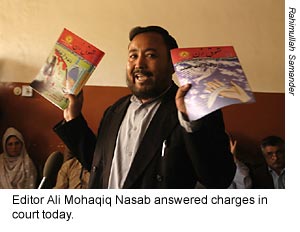
New York, October 11, 2005—The editor of a monthly magazine about women’s rights went on trial today in Kabul’s provincial court on blasphemy charges for publishing articles purported to offend Islam.
The prosecutor asked the court to “severely punish” Ali Mohaqiq Nasab, editor of the monthly Haqooq-i-Zan (Women’s Rights), as “a lesson for him and others,” the Afghan Independent Journalists Association (AIJA) reported. A court official told Reuters that a group of religious leaders were demanding a 10- to 15-year jail sentence for the editor.
Nasab, an Islamic scholar who is defending himself, denied that he had committed blasphemy and attempted to defend the position of the articles in court. Local press freedom advocates who were in court said that Nasab was not allowed to answer the charges in full, and that as many as 15 judges questioned the editor, creating a chaotic atmosphere. The hearing will continue Wednesday.
The attorney general ordered Nasab’s arrest on October 1 after the religious adviser to President Hamid Karzai, Mohaiuddin Baluch, filed a complaint about the magazine. “I took the two magazines and spoke to the Supreme Court chief, who wrote to attorney general to investigate,” Baluch told The Associated Press.
In the allegedly blasphemous articles, Nasab questioned the use of harsh punishments under traditional Islamic law, such as amputating the hands of thieves as punishment for stealing, and publicly stoning those accused of adultery, according to international news accounts. He has been in custody since October 1.
“The arrest and trial of Ali Mohaqeq Nasab on blasphemy charges is a giant step backward for press freedom in Afghanistan,” CPJ Executive Director Ann Cooper said. “Nasab should be released immediately and without condition.”
Writings considered anti-Islamic are prohibited under a revised media law signed in March 2004, but the law is vaguely worded and local journalists are uncertain what constitutes a violation. That uncertainty and this trial could have a chilling effect on writing about religious issues, local media sources say.
The media law also stipulates that journalists can be legally detained only with the approval of a 17-member commission of government officials and journalists. Fazel Sangcharaki, a deputy minister at the ministry of information and culture, told Reuters that Nasab’s arrest was technically illegal, and that the editor should be transferred to the commission’s custody.
In 2003, two editors of the weekly Aftab were jailed for a week on blasphemy charges for publishing a controversial series of articles condemning crimes committed by senior Afghan leaders in the name of Islam. The two editors were later cleared of the charges, but they were forced to leave the country because of threats against their lives.
