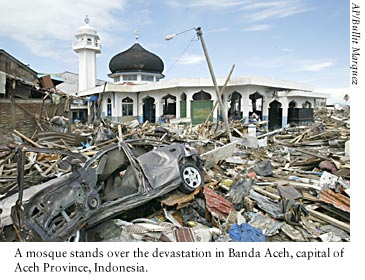
New York, January 13 , 2005—The Committee to Protect Journalists is deeply troubled by Indonesian government restrictions on reporting in the province of Aceh, which was devastated in the December tsunami. CPJ called on the government today to lift the limitations immediately so independent journalists can fully document the massive international humanitarian effort.
“Unrestricted access to information is absolutely crucial during this relief effort,” CPJ Executive Director Ann Cooper said. “We call on Indonesian authorities to drop the restrictions immediately and allow journalists to report freely. The world has been moved by Aceh’s terrible plight and has a deep interest in keeping abreast of the assistance efforts.”
Officials announced this week that foreign journalists and aid workers must report their movements and seek military accompaniment when traveling outside of the provincial capital, Banda Aceh, or the town of Meulaboh, according to international news reports. The rules mean a return, in part, to the severe restrictions that have limited coverage of the ongoing civil conflict in Aceh.
When asked whether journalists would face expulsion if they failed to keep officials informed of their plans, Welfare Minister Alwi Shihab told The Associated Press, “I think that is one possibility.”
The government denied trying to restrict access in the restive region, and said they were only trying to protect foreigners from harm. But officials in Banda Aceh have already denied at least one journalist permission to report on relief activities outside of the major cities. Bruno Bonamigo, producer for the Canadian public broadcasting outlet, Radio Canada Information, told The Jakarta Post that officials had barred him from reporting on the relief efforts of Doctors Without Borders in the north Aceh town of Sigli.
Other journalists reported incidents of official harassment that occurred even before the new restrictions were announced.
On January 6, an Indonesian special forces (Kopassus) commander told two journalists not to report on a skirmish between the Indonesian military and the Free Aceh Movement (GAM), a separatist rebel group. Martin Chulov, a reporter for the Sydney-based daily The Australian, told CPJ that he and photojournalist Renee Nowytager witnessed Indonesian soldiers roughing up citizens they suspected of being GAM sympathizers.
“Your duties here are to observe the disaster, not the conflict between the TNI [the Indonesian army] and GAM,” the Kopassus commander said before expelling the journalists from Lhoknga, a GAM stronghold 25 miles (40 kilometers) from Banda Aceh, according to The Australian. The two continued reporting elsewhere in Aceh without restriction.
Earlier, on December 29, Chicago Tribune reporter Michael Lev told CPJ that he and Indonesian journalist Handewi Pramesti were detained for 28 hours for undisclosed reasons shortly after arriving in Meulaboh, in Aceh. The Indonesian military flew them to the city of Medan before releasing them.
Aceh has been under martial law since 2003 when talks between the government and the separatist GAM broke down; the Indonesian government restricted local reporting and banned foreign journalists from the area at the time. The ban on foreign journalists was eased following the December 26 disaster that has claimed more than 100,000 lives in Indonesia.
In recent years, the military has also ordered local journalists to report only its side of the conflict. Local media in Aceh suffered greatly in the tsunami, when newspaper offices, printing presses and radio stations were wiped out, and dozens of journalists lost their lives.
