New York, September 29, 2005—The Committee to Protect Journalists welcomed today a request by U.S. Senator John Warner, chairman of the Senate Armed Services Committee, for the Pentagon to address concerns about the safety of journalists in Iraq.
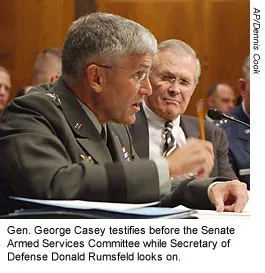
Warner raised the issue at a hearing in Washington with Defense Secretary Donald Rumsfeld and senior commanders. Warner’s request came after he had received copies of letters that CPJ has written to the secretary, and a separate letter from Reuters news agency, as well as a telephone request from Paul Steiger, CPJ chairman and managing editor of The Wall Street Journal. The letters and the request from Steiger outlined several security issues facing journalists working in Iraq.
“I raised the question of the safety of the press in Iraq and their ability to carry out the very important function of reporting to the American people,” Warner told reporters after the hearing. “I’ve discussed it with the secretary. He’s going to take it under immediate consideration,” Warner, a senior Republican from Virginia, added.
Gen. George Casey, U.S. commander in Iraq, told the committee he would follow up the request. “It’s an issue that we take very seriously. And what I will do when I get back to Baghdad is I’ll get a few of the local journalists together and work through some of their concerns with them,” Casey said.
Warner also suggested that Casey meet with organizations that had brought the safety issues to the Senate panel.
In a letter to Secretary Rumsfeld on Wednesday, CPJ said that U.S. forces have routinely detained Iraqi reporters or photojournalists since the March 2003 invasion of Iraq. In several cases, individual journalists have been held for weeks or months without charge or due process.
In 2005 alone, CPJ has documented seven cases in which reporters, photographers, and cameramen were detained for prolonged periods without charge or the disclosure of any supporting evidence. Some of those detained worked for CBS News, Reuters, The Associated Press, and Agence France-Presse. At least four Iraqi journalists remain in U.S. custody.
Earlier this year, CPJ addressed another serious security issue in a joint letter with Human Rights Watch to Rumsfeld, which expressed “ongoing concern about the U.S. military’s failure to develop and implement adequate procedures at military checkpoints in Iraq.” The two organizations added, “More than two years after the March 2003 invasion, flawed checkpoint procedures continue to unnecessarily endanger the lives of civilians and U.S. service members.”
“We applaud the Senate Armed Services Committee’s action,” CPJ chairman Steiger said after the hearing. “We are hopeful that the U.S. military will now take actions to increase checkpoint safety as well as deal with the prolonged, open-ended detention of journalists in Iraq.”
