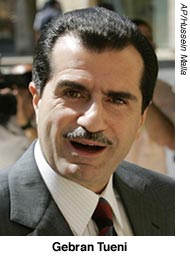
New York, December 12, 2005—The Committee to Protect Journalists condemns the assassination today in Beirut of Gebran Tueni, a journalist and member of parliament who was a fierce critic of Syria and its policies in Lebanon. Tueni, 48, was managing director of Lebanon’s leading daily Al-Nahar.
A parked car exploded as Tueni’s armored vehicle drove past, international news agencies reported. The blast killed three other people and injured 32.
“Our deepest sympathies go out to Gebran Tueni’s family, friends, and colleagues,” said CPJ Executive Director Ann Cooper. “This attack is an assault on free expression and freedom of the press. We call on the Lebanese authorities and the international community to work swiftly to put an end to these attacks on the media and the impunity with which they have been carried out.”
Tueni was killed the day after he returned home from Paris where he had spent considerable time in recent months because of fears for his safety amid a spate of unsolved killings that have targeted Lebanese journalists and politicians. The Lebanese opposition has blamed the attacks on Syria, which has denied them.
The bombing came on the day that the United Nations Security Council was expected to receive the report on a U.N. investigation into the February 14, 2005 assassination of former Prime Minister Rafiq al-Hariri.
CPJ renewed its call for the Security Council to expand the U.N. investigation of al-Hariri’s murder to include the unsolved deaths and attacks on journalists, including that of Tueni. (See CPJ’s October 11 letter to the U.N. Security Council.) Since al-Hariri’s murder and the launch of the U.N. inquiry, prominent Al-Nahar columnist Samir Qassir was killed in one car bombing and a Lebanese Broadcasting Corporation talk show host May Chidiac was maimed in another.
“The failure to bring those responsible for these appalling attacks to justice seriously jeopardizes the ability of all journalists to carry out their work freely,” Cooper added.
In addition to his work in journalism, Tueni was a prominent opposition politician and was active in protests following al-Hariri’s assassination. Those protests helped prompt Syria to withdraw from Lebanon.
But Tueni was perhaps best known for his roles at Al-Nahar, where he was managing director and a columnist. Famous for his columns criticizing the Syrian government and its Lebanese allies, Tueni helped break an important taboo in the press in 2000 when he wrote a front-page letter to Bashar al-Assad, son and heir apparent of Syrian president Hafez al-Assad, calling for the redeployment and withdrawal of Syrian troops in Lebanon under the 1990 Taif Accords that ended Lebanon’s civil war. Although Tueni’s open letter to Bashar al-Assad triggered a public outcry from some newspapers and Lebanese officials, other writers followed his lead.
