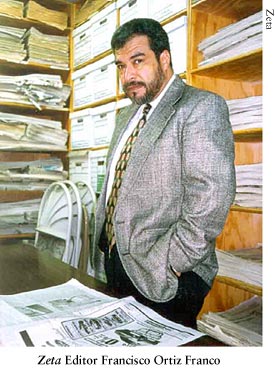
Mexico City, June 21, 2005—A top Mexican prosecutor told a delegation from the Committee to Protect Journalists today that the Arellano Félix drug cartel was behind the slaying of a well-known Tijuana journalist nearly one year ago, and federal authorities have rounded up more than 100 people as part of a broad crackdown against the gang.
The CPJ delegation met with José Luis Vasconcelos, a prosecutor in the organized crime division of the federal Attorney General’s Office, to discuss the government’s investigations into the recent murders of several Mexican journalists. Today’s discussion focused on the slaying of Francisco Ortiz Franco, co-editor of the Tijuana-based weekly Zeta, who was gunned down on June 22, 2004.
Vasconcelos told the CPJ delegation that one of the suspected gunmen in the Ortiz Franco murder, Jorge Eduardo Ronquillo Delgado (known as “El Niño”), was executed by fellow members of the Arellano Félix cartel last October.
In all, he said, 107 people have been detained in a general crackdown undertaken during the probe; most have been charged with other crimes. Vasconcelos said three of those detained were indirectly involved in the Ortiz Franco murder and have been charged. One suspect was linked to the car used in the crime; two others had information about its planning.
Still at large, he said, are the two alleged masterminds: Arturo Villarreal Albarrán (known as “El Nalgón”) and Jorge Briceño (known as “El Cholo”). Authorities have warrants seeking their arrest on drug trafficking charges, he said.
“The discussion was productive, but the true test lies in what Mexican authorities do to stop the slayings of journalists,” said Andrés Oppenheimer, a CPJ board member and a Pulitzer Prize-winning columnist for The Miami Herald. “The fact is that CPJ has identified Mexico as an extremely dangerous country for Latin American journalists, joining company with nations such as Colombia.”
The delegation also included CPJ Deputy Director Joel Simon; CPJ Americas Program Coordinator Carlos Lauría; and prominent Mexican journalists Rossana Fuentes and Jorge Zepeda. CPJ representatives submitted a dossier titled “Journalists Killed in Mexico,” a detailed analysis of murder cases documented by CPJ staff since 2000, the year Vicente Fox was elected president.
Four Mexican journalists have been killed in direct reprisal for their work in the last five years. CPJ is investigating the slayings of five others, whose murders may also be related to their journalism. CPJ research shows that northern Mexico, particularly the U.S.-Mexico border, has become one of the most dangerous places in Latin America for journalists to do their jobs.
In the meeting with Vasconcelos, the CPJ delegation also expressed concern about the fate of Alfredo Jiménez Mota, a crime reporter for the Hermosillo-based daily El Imparcial, who has been missing since April 2. (For details on the case, see CPJ’s April 14 letter to the Attorney General’s Office )
Mexican journalists who work in northern areas and cover sensitive issues such as drug trafficking, organized crime, and political corruption are often targeted for attack because of their coverage. Fox has publicly recognized the problem of violence against reporters and said his government is dedicated to protecting them.
But Mexico’s justice system has failed to bring an end to this cycle of violence and appears far from solving any of the recent murders. The fact that most of these cases remain unsolved has perpetuated a climate of impunity that leaves the media open to continuing attack.
The culture of lawlessness was evident in Tijuana last year when Ortiz Franco was gunned down in broad daylight in a quiet neighborhood just two blocks from state police headquarters. He had just left a physical therapy clinic with his two children when masked gunmen pulled up to his car and shot him four times in the head and neck. The journalist died at the scene; his children were unharmed.
Federal authorities, who took over the probe in August 2004, believe that Ortiz Franco was killed because of his work as a journalist, and they consider stories he wrote about the Arellano Félix cartel as the probable motive.
In September 2004, a CPJ delegation led by Simon and Lauría visited Tijuana for a week to look into the Ortiz Franco murder. With information gathered during the trip, CPJ published a report in November titled “Free-Fire Zone,” describing how feuds between rival drug cartels over lucrative drug smuggling routes have endangered the lives of journalists. ( Read “Free-Fire Zone” ).
Federal prosecutors have also taken over the cases of Guadalupe García Escamilla, a crime reporter with Stereo 91 XHNOE in Nuevo Laredo, in the state of Tamaulipas, who died on April 16 from injuries she suffered in an April 5 shooting in front of her radio station; and Raúl Gibb Guerrero, owner and director of La Opinión, a daily newspaper in the eastern state of Veracruz, who was killed in an apparent ambush in the city of Poza Rica, in the state of Veracruz, on April 8.
Although state prosecutors usually investigate murder cases in Mexico, federal authorities may take over a case if they conclude the killing is related to organized crime.
