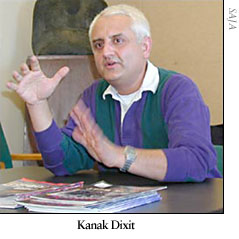
New York, March 8, 2005—The Committee to Protect Journalists welcomes the release early this morning of prominent Nepalese editor Kanak Mani Dixit, who was detained and questioned for roughly five hours last night. At least four journalists jailed since the royal coup on February 1 remain imprisoned.
Officers at the Jawalakhel police station questioned Dixit, who edits and publishes the Nepalese-language Himal Khabarpatrika magazine, mainly about a recent trip to India to attend a seminar, his brother Kunda Dixit told CPJ. Authorities provided no reason for his detention or release.
Dixit has been outspoken in his criticism of King Gyanendra’s February 1 takeover of the government and suspension of civil liberties. Word of the editor’s arrest spread quickly in Kathmandu and internationally, and Dixit took the opportunity of his release this morning to draw attention to grim conditions for human rights workers and the press in Nepal.
“Some of us are privileged in Kathmandu,” Dixit told local reporters, according to Kantipur Online. “But make no mistake, the country’s civil liberties and press freedom have taken a knock. They have been pushed back several decades. The situation of journalists and human rights activists, especially outside Kathmandu, is anything but normal.”
Four journalists imprisoned since the coup remain in custody, including Labadev Dungana, executive editor of eastern Nepal’s Panchther Times and district correspondent for Rajdhani daily, who was detained last week. Journalists Arjun Prasad Shah, Monohar Pokhrel, and D.R. Panta have been imprisoned since mid-February.
Police also detained photographer Ashish Sarraf in the southern town of Janakpur today after he took pictures of street demonstrations, according to Nepalnews.com, an online news Web site. As many as 200 political activists were arrested across the country today after opposition political parties launched protests calling for the restoration of democracy, according to local and international news reports.
Last week, officials from the District Administration Office in Kathmandu interrogated Surya Thapa, editor of Budhabar weekly, about an article detailing political parties’ opposition to the king’s actions. Criticism of the king’s move has been banned in Nepal. If charged, Thapa could face one year in jail for publishing prohibited material, according to local news reports.
“CPJ welcomes the release of Kanak Dixit, whose imprisonment signals the government’s appalling ill-will toward the press, not to mention a disregard for its own international reputation,” said CPJ Executive Director Ann Cooper. “We call on authorities to release all other imprisoned journalists, and to lift the press restrictions that Dixit has bravely condemned.”
Hundreds of journalists working for more than 40 private radio stations across Nepal have lost their jobs following a ban on the private broadcasting of news last month. Hundreds of other journalists face layoffs as newspapers lose advertising revenue due to the political crisis.
Recent restrictions on the press require military vetting of reporting on the ongoing Maoist conflict. Censorship of newspapers based outside of Kathmandu has been particularly strict.
