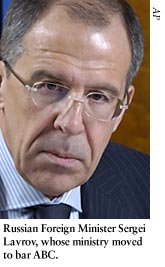
New York, August 2, 2005—The Kremlin escalated its campaign of intimidation against foreign news media covering the war in Chechnya as authorities began moving today to bar the U.S. television network ABC from reporting in Russia. The Committee to Protect Journalists denounced the decision and called for its reversal.
The Russian Foreign Ministry said in a statement that ABC reporters are barred from speaking with government officials and that their accreditations will not be renewed when they expire. Russian authorities went on the offensive after the network broadcast an interview with Chechen rebel leader Shamil Basayev on its news program, “Nightline,” last Thursday.
“ABC is undesirable for contact with all Russian government organizations and bodies,” the ministry’s statement said. It criticized the Basayev interview as “clearly supporting the propaganda of terrorism” with “calls for violence against Russian citizens.”
“Nightline” anchor Ted Koppel said last week that “broadcasting an interview with someone does not imply any sort of approval of that person or his actions.” ABC did not immediately comment today on the ministry’s decision.
“This action reflects the Kremlin’s growing intolerance of any kind of criticism, especially in regard to its actions in Chechnya,” CPJ Executive Director Ann Cooper said today. “The Russian Foreign Ministry is clearly trying to intimidate foreign journalists into censoring their news reporting on the war in Chechnya. We call on the ministry to reverse its decision immediately.”
Today’s announcement comes against a backdrop of Kremlin censorship of independent news coverage in Chechnya. A yearlong CPJ investigation, published in May, found that the Kremlin has used repressive policies, restrictive rules, harassment, obstruction, and outright attacks to suppress coverage of the war. Read CPJ’s report (pdf),
The announcement came two days after Russian Defense Minister Sergei Ivanov declared that ABC reporters were “persona non grata” in his ministry, according to local and international news reports. On Friday, the Foreign Ministry issued a formal complaint to the U.S. embassy’s charge d’affaires in Moscow, Daniel Russell.
Basayev has taken responsibility for many violent actions, including the deadly September 2004 attack on a school in Beslan that claimed the lives of 330 hostages. Russian authorities have offered a $10 million reward for his capture.
The interview was conducted by Russian journalist Andrei Babitsky, who has been persecuted by Russian authorities over his reporting on the war in Chechnya. The Foreign Ministry, which monitors the work of foreign media in Russia, said today that it would also investigate Babitsky for allegedly conducting the interview in Chechnya in June without proper accreditation.
Babitsky said the Kremlin’s strong response was prompted by the failure of Russian authorities to capture Basayev. “The security services are embarrassed because they have spent vast sums over six years but they still can’t catch Basayev, and here he is talking to a journalist. …This shows how ineffectively they are working,” Babitsky told the Reuters news service.
Already this year, Russian authorities have pressured both Britain and Sweden after independent media in those countries aired interviews with the rebel leader.
On March 24, the Russian embassy in Stockholm criticized the independent Swedish news agency TT for broadcasting a similar interview with Basayev. A month earlier, on February 3, the Russian Foreign Ministry requested that British authorities prevent the independent television station Channel 4 from broadcasting an interview with Basayev. The British Foreign Office said it could not interfere with the station’s editorial policies.
