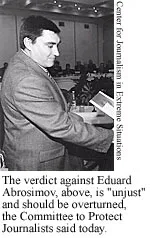
New York, June 24, 2005—An arbitration court in the southern Russian city of Saratov convicted Eduard Abrosimov, a journalist and adviser to former regional governor Dmitry Ayatskov, of criminal defamation on Wednesday and sentenced him to seven months in a prison colony for defaming public officials in two articles published last year in national and local newspapers, according to local press reports.
On one of the counts, the court convicted Abrosimov of defamation based on material that was not published. It was the second prison term for criminal defamation handed down against a Russian journalist this month.
The Volga Region Arbitration Court sentenced Abrosimov under Article 129.2 (defamation, disseminated through the mass media) and Article 129.3 (defamation involving accusation of a serious crime) of the Russian Criminal Code. Guards took him to a detention unit immediately after the verdict was read. The defense will appeal the sentence, the Moscow-based independent daily Kommersant reported.
On November 2, 2004, the Moscow weekly newspaper Sobesednik published the article, “Don’t look through the keyhole,” written by Abrosimov and published under the pseudonym Andrei Zabelin. The article referred to the purported sexual orientation of State Duma Vice Speaker Vyacheslav Volodin. The prosecution said the article damaged Volodin’s professional reputation while Abrosimov’s defense argued that there were no defamatory elements, local reports said.
On November 11, 2004, the Saratov regional newspaper Saratov Stolitsa Povolzhya published Abrosimov’s article, “Thinking over a portrait,” criticizing local government corruption. Abrosimov was not prosecuted for the article itself, but for an unpublished draft suggesting that an investigator in the Saratov regional prosecutor’s office took bribes to release crime suspects from detention, according to local press reports. The passage was omitted from the published article, local reports said. Prosecutors charged Abrosimov with defaming the investigator in the unpublished version, which they found on the journalist’s computer as well as in an e-mail he sent to the Saratov Stolitsa Povolzhya‘s newsroom.
Lev Levinson, a human rights lawyer, said Russian law defines defamation as the spreading of false information, even to a small group of people, the Moscow Times reported. Regardless, he called a prison term for unpublished material “unthinkable.”
Abrosimov, known best as a political and public relations adviser, was arrested on January 20 on orders of the Saratov regional prosecutor’s office and charged with criminal defamation. He spent nearly four months in detention before he was released in early May on condition that he not leave Saratov, local reports said.
Prosecutors called Abrosimov’s pre-trial detention a preventive measure to stop him from continuing his criminal activity, the Russian information agency Regnum said. The time Abrosimov spent in detention will be counted toward his sentence, Kommersant reported.
“Finding someone guilty of defamation for material that was not published defies reason. It shows instead the predisposition of authorities to punish someone who scrutinized the work of public officials,” CPJ Executive Director Ann Cooper said. “We are very disturbed by the long pre-trial detention of our colleague, Eduard Abrosimov, and we call on Russian authorities to overturn this unjust verdict. Journalists should not be imprisoned for what they write.”
Abrosimov is the second Russian journalist handed a prison sentence for criminal defamation this month. On June 6, an arbitration court in the central Russian city of Smolensk convicted independent journalist Nikolai Goshko to five years in a prison colony for defaming local officials in a 2000 radio broadcast. Read CPJ’s related alert here: http://www.cpj.org/news/2005/Russia15june05na.html
