New York, September 9, 2005—The Committee to Protect Journalists is alarmed by police violence against reporters in New Orleans and attempts by the authorities to restrict coverage of the aftermath of hurricane Katrina.
U.S. and international media outlets have complained of attacks on staff and the confiscation of film of shoot-outs between police and looters in the first days after the storm devastated the Gulf region. They have also cited an attempt to restrict coverage by the Federal Emergency Management Agency (FEMA). The agency, which has been heavily criticized for its initial slow response to the disaster, has publicly asked news organizations not to photograph bodies being recovered in Louisiana and Mississippi.
On September 1, police in New Orleans ripped a camera from the neck of Lucas Oleniuk of the Toronto Star who had photographed clashes between police and looters. They removed memory cards, robbing Oleniuk of more than 350 images, which included shots of “officers delivering a fierce beating to two suspects, an assault so fearsome one of the suspects defecated,” the Toronto Star reported.
The same day Gordon Russell of the New Orleans-based Times-Picayune wrote that he and a New York Times photographer, whom he did not name, were forced to flee the scene of a shoot-out between police and residents near the Convention Center where hurricane victims were awaiting evacuation after officers slammed the journalists against a wall and threw their gear to the ground.
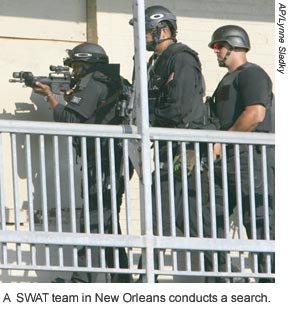
On September 7, Peter Fimrite of the San Francisco Chronicle said he was surrounded by a New Orleans police SWAT team for being out on the street after dark. He was trying to find a cell phone signal on a street where 17 journalists from the Hearst Corporation were housed. A guard hired to protect the journalists called the police action unprofessional and said that the Army had been patrolling the street for a week and knew of the journalists’ presence. He criticized the police for not coordinating with the Army.
Brian Williams, anchor for U.S. broadcaster NBC, said he and his crew were ordered to stop trying to film a National Guard unit securing a store in downtown New Orleans on September 7. “I have searched my mind for some justification for why I can’t be reporting in a calm and heavily defended American city and cannot find one,” Williams was quoted by the Washington Post as saying. “I don’t like being told when I can and cannot walk on the streets and take pictures,” he added. Journalists have been angered by FEMA’s “request” to avoid filming the dead. The Washington Post reported that some Louisiana officials, whether taking their cue from FEMA or not, were attempting to make the policy mandatory. Washington Post reporter Timothy Dwyer said he heard a sergeant from a state agency telling a camera crew allowed on a boat in a flooded area near downtown New Orleans, “If we catch you photographing one body, we’re going to bring you back in and throw you off the boat.” The irony, Dwyer said, was that two bodies — one in a black bag, the other covered by a blue quilt — were visible on the off-ramp of Interstate 10 that the boats were using as a staging area.
“The security forces must allow journalists to work freely and stop all attacks and harassment of reporters immediately,” said Ann Cooper, CPJ Executive Director. “Federal, state and local authorities should not attempt to censor coverage of this national tragedy,” she added.
Journalists have also been assaulted by looters and one was shot and wounded in an apparent robbery attempt.
