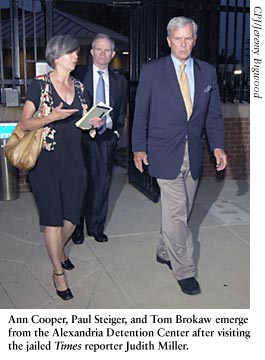
Alexandria, Va., July 28, 2005—A delegation from the Committee to Protect Journalists met with jailed New York Times reporter Judith Miller in the Alexandria Detention Center tonight to deliver a message of support and call for an immediate end to her imprisonment.
Paul Steiger, CPJ chairman and Wall Street Journal managing editor, headed the delegation, which included Tom Brokaw of NBC News and CPJ Executive Director Ann Cooper. The group talked with Miller for a half hour though a clear plastic partition.
“There’s no good purpose in keeping this dedicated, honorable, committed professional in jail,” Steiger said after the visit. Added Brokaw: “At the end of our 30-minute conversation it was emphatically clear that she is absolutely convinced that she made the right decision and is prepared to stay the course.”
Wearing a dark green prison uniform with “PRISONER” written in capital letters on the back, Miller described the conditions and her daily routine. While she praised the professionalism of the detention center staff and said she is allowed to read and write, Miller has been able to go outside just twice in three weeks. The crowded facility is subjected to random lockdowns for security reasons.
In a statement released tonight, CPJ’s 35-member board said it “strenuously protests” Miller’s July 6 imprisonment, which was ordered by U.S. District Court Judge Thomas F. Hogan after the reporter refused to testify about a confidential source before a grand jury investigating the 2003 leak of a CIA operative’s identity. Miller was ordered jailed during the term of the grand jury, now due to expire in October.
In calling for Miller’s immediate release, the statement noted that more than 120 journalists were imprisoned around the world at the end of 2004, “primarily in China, Cuba, Eritrea, and other countries where journalists are frequently locked up in the course of practicing their profession.”
By jailing Miller, the statement said, “the U.S. government is not only undermining the ability of a free press to function in this country but also sending a signal to other governments that such a course is acceptable when dealing with journalists of whose actions they do not approve.”
CPJ, a New York-based nonprofit organization that monitors press freedom conditions in more than 100 countries, compiles an annual census of journalists imprisoned because of their work.
A February analysis by CPJ showed that 20 nations worldwide were imprisoning a total of 122 journalists on Dec. 31, 2004. More than three-quarters of the imprisoned journalists were held in four countries with long records of press repression: China, Cuba, Eritrea, and Burma. For the first time in three years, the United States joined the list of countries imprisoning journalists. Providence, R.I., television reporter Jim Taricani was sentenced to home confinement in December 2004 for not revealing the source of a leaked government surveillance tape. He was released earlier this year.
The CPJ representatives said tonight that they shared Miller’s concerns that this vital issue—the protection of confidential sources to ensure the free flow of information—not be allowed to fade away.
“Only a minority of countries worldwide imprison journalists for their work,” Cooper said. “The United States, long seen as setting a global standard for freedom of the press, is damaging its international reputation by jailing journalists.”
Here is the full text of CPJ’s board statement:
STATEMENT FROM THE BOARD OF DIRECTORS OF CPJ
The Committee to Protect Journalists strenuously protests the imprisonment of New York Times reporter Judith Miller. Monitoring the jailing of journalists is one of the committee’s main missions. According to CPJ research, more than 120 journalists were in jail around the world at the beginning of 2005, primarily in China, Cuba, Eritrea, and other countries where journalists are frequently locked up in the course of practicing their profession.
In jailing Ms. Miller, the U.S. government is not only undermining the ability of a free press to function in this country but also sending a signal to other governments that such a course is acceptable when dealing with journalists of whose actions they do not approve.
We, the members of the board of the Committee to Protect Journalists, urge Judith Miller’s immediate release.
