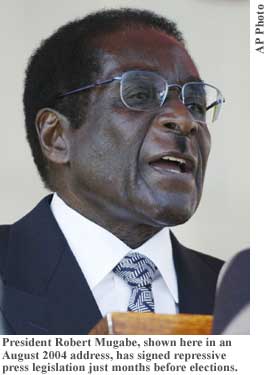
New York, January 10, 2005 —Zimbabwe’s President Robert Mugabe has signed into law a measure that sets prison terms of up to two years for any journalist found working without accreditation from the government-controlled Media and Information Commission. The Committee to Protect Journalists urges Mugabe and his government to turn away from such measures, including another piece of repressive legislation still pending.
The newly enacted measure stiffens the 2002 law known as the Access to Information and Protection of Privacy Act (AIPPA), which has already been used to shutter Zimbabwe’s only independent daily newspaper, the Daily News. The measure, titled the AIPPA Amendment Act, took effect on January 7.
Parliament passed the AIPPA Amendment Act in November as one in a series of draconian measures adopted in advance of general elections scheduled for March. Critics say the measures are intended to intimidate the last vestiges of the independent press: Two independent weekly newspapers still operate in Zimbabwe, and some local correspondents work for foreign news agencies.
Other new legislation includes the Criminal Law (Codification and Reform) Act, which could be used to jail journalists for up to 20 years for publishing or communicating to any other person “false” information deemed prejudicial to the state. CPJ sources said the law could be used to intimidate journalists and the sources upon which they rely. They also fear its broad language could be used against Zimbabweans who communicate with news outlets and other organizations based abroad.
The Criminal Law (Codification and Reform) Act awaits Mugabe’s signature.
“CPJ is deeply troubled by these measures, which will have a further chilling effect on independent journalism in Zimbabwe,” CPJ Executive Director Ann Cooper said. “We call on Zimbabwe’s government to reject all repressive media legislation and to ensure a free media climate for elections, in line with its own commitments to the Southern African Development Community.”
The Southern African Development Community (SADC) comprises 14 southern and central African countries, including Zimbabwe, and promotes sustainable development, democracy, peace and security.
“CPJ calls on SADC—and particularly South Africa’s influential president, Thabo Mbeki—to hold Zimbabwe accountable to regional democratic standards, “ Cooper said. “With the election approaching, it’s more important than ever that the press be allowed to report freely.”
Mbeki has been mediating between the Mugabe government and Zimbabwe’s main opposition party, the Movement for Democratic Change, but he has been muted in his public comments on Zimbabwe’s appalling human rights and free press record.
In 2004, CPJ named Zimbabwe one of the 10 worst places in the world to be a journalist. Last month, CPJ wrote to President Mugabe urging him not to sign the latest repressive media legislation.
To view the letter click here.
