July 12, 2000
His Excellency Jiang Zemin
President, People’s Republic of China
Beijing 100032
People’s Republic of China
VIA FACSIMILE: 86-10-6512-5810
Your Excellency:
The Committee to Protect Journalists (CPJ) strongly condemns the imprisonment of Huang Qi and Qi Yanchen, both of whom have been charged with subversion for allegedly posting anti-government articles on the Internet.
Though the two cases are separate, CPJ believes that, considered together, they represent a disturbing feature of your government’s concerted strategy to control the Internet. By jailing individuals who use the new media to circulate news and information, your administration sends a chilling signal to the international community and to corporations eager to invest in China’s enormous market for high technology.
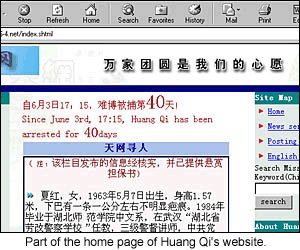
Huang Qi, owner of the Web site www.6-4tianwang.com, was imprisoned in Chengdu, Sichuan Province, along with his wife, Zeng Li, on June 3–the day before the 11th anniversary of the Tiananmen Square massacre.
At 5:00 p.m., four officers from Chengdu’s Public Security Bureau (PSB) came to Huang’s office to deliver an oral summons for his interrogation. They left after Huang requested a written summons, according to his own account, which he immediately posted on his Tianwang Web site. Huang, anticipating his arrest, continued to post updates on his website until 5:20 p.m. when around a dozen PSB officers arrived at the office. They raided the premises, confiscating notebooks, photographs, and computers. Both Huang and his wife Zeng were taken into custody.
Just before the arrival of arresting officers, Huang had written a final posting to the site: “Thanks to everybody devoted to democracy in China. They are here now (the policemen). So long.”
Zeng was released on June 6. Later that day, she was informed by the PSB that Huang was being charged with subversion, according to the Hong Kong-based Information Center for Human Rights and Democracy.
The Tianwang Web site was established in June 1999 to publicize information about missing people. Gradually, it also began to feature comments and news articles on topics not normally covered by the state-controlled media. The site published stories about human rights abuses, government corruption, and–just days before Huang was taken into custody–several pieces about the Tiananmen Square massacre.
After Huang’s arrest, a message posted on the Tianwang site condemned the “political persecution” of Huang Qi, and noted that authorities had shut down the Web site at the end of February because it “posted a lot of internal news that upset the leaders.”
The Web site was relaunched in mid-March with the help of a United States-based Internet service provider and continues to be regularly updated. It now features a log of the number of days Huang has been in prison, which today stands at 40.
Elsewhere in China, freelance journalist Qi Yanchen has been imprisoned for 315 days on broadly similar grounds as Huang. Police arrested Qi on September 2, 1999, at his office in Botou, a suburb of Cangzhou, Hebei Province, on allegations of “spreading anti-government messages via the Internet.” Qi’s wife told reporters that police confiscated his computer, printer, fax machine, and documents.
Qi, who was employed as an economist with the local branch of the Agricultural Development Bank of China, had published many articles in intellectual journals. He was the chief editor of Consultations, a short-lived online publication linked to the banned China Development Union. He also contributed to the pro-democracy electronic newsletter VIP Reference, published by U.S.-based Chinese dissidents. Qi wrote under the pen name Ji Li.
On May 30, nearly nine months after his arrest, Qi was prosecuted for subversion before the Cangzhou People’s Court. The half-day trial was closed to the public, but CPJ’s sources said that the prosecution cited an article about the crackdown on the China Development Union, published in Hong Kong’s Open magazine, and a story about the Falun Gong spiritual movement, published by VIP Reference. Qi’s arrest came shortly after he posted online excerpts from his unpublished book, The Collapse of China; the manuscript discusses the causes of China’s social instability and proposes possible reforms. CPJ could not confirm whether prosecutors used the book excerpts as evidence in the subversion trial.
The court has not yet announced a verdict, according to CPJ sources.
Subversion charges are often used against journalists and political dissidents. Those found guilty are typically sentenced to long prison terms, and may be jailed for life.
As a nonpartisan organization of journalists dedicated to the defense of press freedom around the world, CPJ is outraged by the prolonged imprisonment of Huang Qi and Qi Yanchen, and urges Your Excellency to order their immediate release. We believe that articles which raise questions about China’s social and economic policies do not pose any danger to the state, and are essential to the development of a healthy political system.
CPJ respectfully reminds Your Excellency that China has signed the International Covenant on Civil and Political Rights, under which your government is obliged to ensure that citizens are free to seek, receive, and impart information and ideas of all kinds, without interference.
We thank you for your attention to these urgent matters, and eagerly await your response.
Sincerely,
Ann K. Cooper
Executive Director