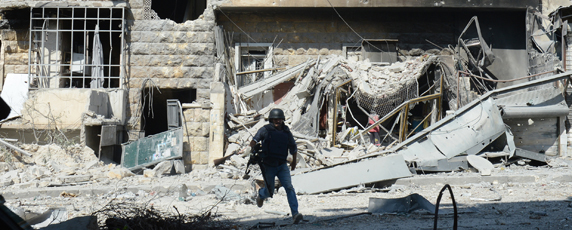
Syrian violence contributed to a sharp rise in the number of journalists killed for their work in 2012, as did a series of murders in Somalia. The dead include a record proportion of journalists who worked online. A CPJ special report

Syrian violence contributed to a sharp rise in the number of journalists killed for their work in 2012, as did a series of murders in Somalia. The dead include a record proportion of journalists who worked online. A CPJ special report
Syrian leaders tried to impose a media blackout on the country's civil war. They failed. As CPJ's Dahlia El-Zein reports, foreign journalists responded by smuggling themselves into the country, while Syrians picked up cameras and uploaded videos online. They all did so at extreme risk. (4:13)
Read CPJ's special report on journalists killed in Syria and worldwide in 2012. And visit our interactive database.
Worldwide tally reaches highest point since CPJ began
surveys in 1990. Governments use charges of terrorism, other anti-state offenses
to silence critical voices. Turkey is the world’s worst jailer. A CPJ special report
Turkish authorities are engaging in widespread criminal prosecution and jailing of journalists, and are applying other forms of severe pressure to promote self-censorship in the press, a CPJ analysis shows. CPJ has found highly repressive laws, particularly in the penal code and anti-terror law; a criminal procedure code that greatly favors the state; and a harsh anti-press tone set at the highest levels of government. Turkey’s press freedom situation has reached a crisis point. A special report by the Committee to Protect Journalists
CPJ’s Nina Ognianova describes the widespread criminal prosecution and jailing of journalists in Turkey. A vast and repressive legal structure, combined with a harshly adversarial tone set at the highest levels of government, have created a crisis, says Ognianova, lead author of a new CPJ special report. Listen to the podcast on the player above, or right click here to download. (2:22)
Read CPJ's special report, "Turkey's Press Freedom Crisis."
In the pitched battle between Cristina Kirchner’s administration and critical
media outlets such as those owned by Grupo Clarín, the very credibility of
journalism is at stake. Argentine citizens are deprived of objective sources of
information on vital political and economic issues. A CPJ special report by Sara Rafsky
Vietnamese officials are stepping up repression of old and new media even as they promote an image of an open, globalized economy. Intense surveillance and imprisonment of critical journalists, coupled with increasingly restrictive laws, are choking the flow of information. A CPJ special report by Shawn W. Crispin
In more than a decade in power, President Hugo Chávez Frías has
overseen the transformation of nearly every aspect of Venezuelan society,
including the media. When Chávez came to office in 1999, he enjoyed the support
of the country’s established private media. But the relationship soon soured,
and in April 2002 he was briefly deposed in a coup that he alleges was carried
out with the support of key media owners. Today, several of the most critical
media outlets are either gone or scared into silence, and a vast state media
presence echoes the government’s positions. By Joel Simon
The Chávez administration has used an array of legislation, threats, and regulatory measures to gradually break down Venezuela’s independent press while building up a state media empire—a complete reversal of the previous landscape. One result: Vital issues are going uncovered in an election year. A CPJ special report by Monica Campbell
Many state media in Latin American are used for political propaganda, but the Venezuelan government has built an unprecedented media empire that it uses to attack critics and independent journalists and obscure issues like crime and inflation. By Carlos Lauría
The recent regulatory probe into coverage at Globovisión, the only TV broadcaster critical of the Chávez administration, is the latest in a long string of investigations and other harassment. The network is struggling to stay afloat. By Monica Campbell
The mysterious group N33 has targeted the online accounts of journalists critical of the Chávez administration. The victims are subject to fake messages, insults, and intimidating threats. By John Otis
Since President Hugo Chávez Frías took office more than a decade ago, legislation, threats, and regulatory measures have withered Venezuela’s independent press even as the state has built a huge media empire. Carlos Lauría, CPJ's Americas Senior Program Coordinator, talks about the developments in this podcast. Listen on the player above, or right click here to download an MP3. (2:05)
Read CPJ's special report, "Venezuela’s private media wither under Chávez assault."
Fifty-seven journalists fled their country in the past year, with Somalia sending the greatest number into exile. Journalists also fled Ethiopia, Eritrea, and Rwanda--mostly for Kenya and Uganda. Exiles in East Africa must grapple with poverty and fear. A CPJ special report by María Salazar-Ferro and Tom Rhodes
Azimjon Askarov, an investigative reporter and human rights defender, had ended careers and embarrassed officials time and again with his reporting on law enforcement abuses in southern Kyrgyzstan. When ethnic unrest broke out in June 2010, authorities struck back with a vengeance. A CPJ special report by Muzaffar Suleymanov
CPJ Deputy Director Robert Mahoney counts down the 10 countries where the press is most tightly restricted. How do leaders in these nations silence the media? And which country is the worst of all? (4:03)
Read CPJ's report on the 10 Most Censored countries for more detail on how censorship works, and which countries were the runners-up.
By Frank Smyth/CPJ Senior Adviser for Journalist Security
With a chapter on Information Security by Danny O’Brien/CPJ Internet Advocacy Coordinator
CPJ's María Salazar-Ferro names the 12 countries where journalists are murdered regularly and governments fail to solve the crimes. Where are leaders failing to uphold the law? Where are conditions getting better? And where is free expression in danger? (4:46)
Read CPJ's 2012 Impunity Index. And visit our Global Campaign Against Impunity and see how you can help.