3. Made in China: Models for media and censorship
By Danny O’Brien and Madeline Earp
As the founding editor, in 2005, of the Liberian online investigative news site FrontPage Africa, Rodney Sieh has fought off lawsuits, imprisonment, and death threats. In the face of such pressures, he has still managed to expand the website into one of Liberia’s best-selling daily newspapers, making him a leading figure in both new and traditional news media in the country. It’s not surprising then, that he was one of 17 prominent African journalists and publishers invited by the Chinese government to a three-week “News and Publishing Seminar in Developing Countries” last August in Beijing.
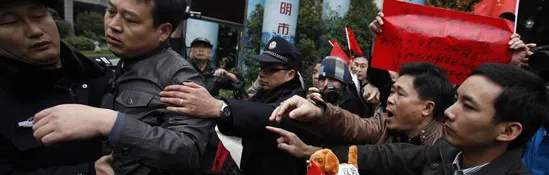
When he arrived, however, Sieh said he found himself within a crowd not just of what he describes as “real journalists” but also “spokespersons and mouthpieces from not-so-press-friendly nations” including Uganda, Burma, and Pakistan. During the conference, a fellow attendee from Burma handed him a business card with the title “Director for Media Censorship.” Instead of training on how to fund and operate his newspaper, Sieh described a course filled with propaganda for the Chinese model of media, with his hosts providing evasive replies about media freedom within China and the government financing of publications. “Of course they expect in return that one would write or promote positive stories about China and how it is opening up,” Sieh told CPJ.
CHALLENGED IN CHINA
• Table of Contents
Interactive graphic
• How Bo Xilai Story Broke
Video
• Censored: An Inside View
In print
• Download the pdf
In other languages
• 中文(pdf)
China’s increased investment in the wider world is nowhere clearer than in Africa. Trade between the nation and continent grew to $166.3 billion in 2011, according to Chinese government sources. In 2009, China’s Prime Minister Wen Jiabao committed to $10 billion in low-interest loans to Africa between 2009 and 2012. The increase in trade includes a growing footprint in the region for Chinese media. Take Kenya: In December 2011, China’s state-run, English-language newspaper, China Daily, launched the publication of an African edition based in Nairobi. It joined CCTV Africa, which has been broadcasting from Kenya’s capital since the beginning of 2012, and Xinhua Mobile Newspaper, a mobile phone news service provided by China’s state wire service and available to 17 million Kenyans since 2010. It’s not surprising that domestic journalists bridle at the competition, even when not directly supported by China’s government. After StarTimes, a Chinese media company, won Kenya’s only digital TV broadcasting license in 2011, an editorial in the Daily Nation challenged the deal, asking: “Websites in China were shut down in reaction to the revolutions that swept across North Africa and the Middle East. Is this the country we want to look up to in matters of freedom of speech and expression?”
The danger for fledgling media is that repressive governments do look to China, particularly when trying to understand how best to limit the reach of online media. The wealth and expansionism of the Chinese state, combined with widespread knowledge of how China’s Internet is restricted and censored, has made China a model for regimes that want to keep free discussion in check. The country’s management of online media looks especially appealing to authoritarians when compared with the alternatives: Tunisia’s revolution was fueled in part by activity on the Facebook website that—unlike opposition-run blogs—the country’s leaders chose not to block (in part, because they used it themselves). China has not only blocked Facebook, Twitter, and other international social networking sites, it has used their absence to encourage domestic versions, such as Sina Weibo (similar to Twitter) and RenRen, a Facebook look-alike, both of which are strongly self-censoring. The Chinese government did not respond to CPJ’s written request, sent via the Chinese Embassy in Washington, D.C., to comment for this report.
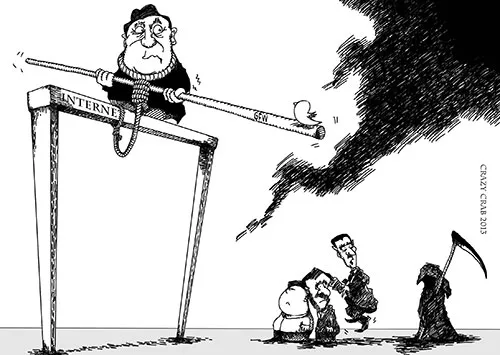
When former Egyptian President Hosni Mubarak’s regime shut down the Internet in January 2011, the move did little but increase street protests and hasten his departure. The Chinese, faced with unrest in the Western province of Xinjiang in 2009, successfully cut off Internet service to the entire population of the region—some seven million users. The action was “mainly to prevent mobile and Internet being used to mobilize and coordinate more violent actions, including hate speech, and spreading of news,” said Xiao Qiang, founder and editor-in-chief of China Digital Times. Its success, Xiao said, was largely because of a massive military presence compared with Egypt, “where a much larger proportion of the population were pouring onto the streets with no military forces.” Nonetheless, the success of China’s intervention against Internet influence boosted the argument that it could work elsewhere.
The recipe for the China model of Internet control is not hard to understand. The country has strong filters on all traffic passing across its borders, through the technology of its Great Firewall. Websites outside of China can be either blocked entirely or individual pages can be blocked by the presence of a keyword. The entirety of Facebook is inaccessible to Chinese citizens; a page that mentions the banned spiritual movement Falun Gong will be inaccessible, regardless of which website on which it appears. Within China, Web hosting companies and services such as microblog sites and chat boards are instructed to delete and block a wide range of political material. Internet users are made aware of these policies by warnings of illegal content, and very direct consequences for wandering into dangerous territory. Typing banned keywords into search engines or Web forms will result in a lost connection to the site for as long as 30 seconds. Blocking every forbidden source of information online may be impossible—but making sure most citizens know that they are being watched, while keeping tight control on local media, is sufficient to limit the damage of many fast-moving controversies. For example, in March 2012, just days after Bo Xilai was forced to relinquish his post as head of the Communist Party in Chongqing, a Ferrari crashed on a Beijing beltway, killing the young male driver and seriously injuring two female occupants, one of whom later died. Although the Beijing Evening News published a photo and brief article on the crash, it was quickly deleted, and online search terms such as “Ferrari” were blocked. Only about six months later did it emerge that the Ferrari driver had been the son of a powerful Communist Party official, Ling Jihua; the scandal likely cost him a post in China’s top leadership, international media reported.
Iranian academic Siavash Shahshahani, known as the founder of the Iranian Internet, has commented that his government’s plans for a “national Internet” are based on China’s censorship model, with foreign connections to be passed through a controllable channel (Tehran has also promised users local equivalents of services such as Google Gmail). Sana Saleem, a digital rights activist working in Pakistan, says recent plans by the Pakistani government to deploy a filtering system capable of blocking 50 million Web addresses reflects an admiration of “China and how it filters the Internet.” That plan was later abandoned due to international outcry and a legal challenge from Pakistani Internet freedom groups. Vietnam has previously attempted to emulate China’s approach of blocking external sites and encouraging local versions, with a government-sponsored Facebook equivalent.
Although Beijing furnishes these countries with a model, it’s not clear that it also supplies the technology to carry it out. Chinese companies ZTE and Huawei are global exporters of telecommunications equipment; Huawei, whose founder is a former Chinese Army officer and whose ownership structure isn’t known, is one of the world’s largest suppliers. The U.S. Congress, in October 2012, branded both companies a security threat, not long after Australia barred Huawei from a $37.5 billion project to build a national broadband network, as Forbes reported. Yet there is no evidence that hardware exported by these companies is sold specifically with tools to implement the Chinese model of surveillance or censorship.
“We know Huawei and/or ZTE make routers and switches … and almost by definition, that’s the level on which cyber-censorship takes place. But I know of no cases where the Chinese have exported the Great Firewall [through sales of tailored hardware or software],” says Eric Johnson, a security researcher who specializes in censorship in developing countries. While many countries now censor the Internet, the specific technical patterns of the Great Firewall’s implementation, including its characteristic lost connections, have not been detected by experts elsewhere in the world. The Chinese model not only requires technology, it also depends on a heavy investment in human manpower, both within the state infrastructure and in private companies. The lack of pre-packaged technology notwithstanding, the success of the Chinese firewall has inspired others to seek barriers of their own.
Even countries with strong reputations for press freedom, such as Australia, have been influenced by China’s success. In 2010, Stephen Conroy, Australia’s communications minister, noted during a debate over plans for mandatory filtering for adult Internet content in the country that Google should be able to censor YouTube videos, as “they have experience in blocking material in other countries at the behest of governments, including China.” In response, Iarla Flynn, head of policy at Google Australia, said, “We don’t believe the comparisons between how China filters the Internet, and how Australia is looking at it, are relevant.” But he admitted that Google was “committed to complying with relevant laws in the countries we operate in,” including, at the time, the censorship rules of the Chinese firewall. Google since stopped self-censoring its Chinese-language service and redirected users to an uncensored site hosted in Hong Kong.
Within Australia, Chinese-language local news media is also influenced by Beijing. As China correspondent John Garnaut wrote in The Sydney Morning Herald, government-owned China Radio International, while lacking a license to operate in Australia, widely disseminates content to the large ethnic Chinese community through joint ventures with a local entrepreneur, Tommy Jiang, who also owns several Chinese-language newspapers. “Australian bureaucrats have approved and some Australian politicians have personally endorsed what amounts to the takeover of virtually all Chinese-language media in Australia by the Chinese Communist Party’s Propaganda and United Front Departments,” Garnaut told a closed email list of China watchers.
Modern superpowers have always used the “soft power” of economic and cultural dominance to bend the other countries’ media to their orbit. United States government aid organizations have long paid for journalists in Africa and other developing regions to be trained in Western journalism tradition. State-funded outlets like Voice of America and BBC have set up shop, broadcast to, and influenced local media markets across the world, including in Africa, East Asia, and Australasia. Unlike Chinese state-owned media, however, Western outlets attempt to keep politics at a distance with mechanisms like the BBC’s charter guaranteeing independence and its board of trustees. “We know some politicians see the BBC as an instrument of soft power, and we see many countries interested in soft power now investing millions in global news channels,” said Jim Egan, chief operating officer for BBC Global News in London. “British politicians have understood for a long time that organizational and editorial independence is key to getting credit for international broadcasting. It’s in everybody’s DNA at the BBC that we do not answer to government for our journalism and for their part government acknowledges the importance of this independence.” The risk of China’s growing engagement is the export of a self-censoring, often unitary state media—and the norm that online news, rather than being a Wild West of uncensorable voices, can and should be filtered by government actors.
Controlling the unruly Internet is an easier sell in international forums than advocating for traditional press restrictions. In 2011, China joined Uzbekistan, Tajikistan, and Russia at the United Nations to propose an Internet “code of conduct” that would establish “international norms and rules guiding the behavior of states in the information space.” Included in the proposal was a commitment to “curb the dissemination of information that incites terrorism … or that undermines other countries’ political economic and social stability.” That proposition attracted no support outside the group, but Russia and China, as well as Saudi Arabia, the United Arab Emirates, Algeria, Sudan, and Egypt later worked together on a proposal for the U.N.’s International Telecommunication Union which would have passed control of key Internet resources from private hands to the government-dominated ITU. These countries share the view that the Internet should be monitored and filtered closer to home: the Chinese model. “The Chinese government’s legal management of the Internet is in line with international practice” is how Chinese Foreign Ministry spokeswoman Jiang Yu expressed it at a press conference in mid-2011. With each country that introduces internal Internet censorship—and the number is growing—that statement becomes more accurate.
China’s global media presence is growing and is carried, for now, on the back of its status as a trading and aid-granting power. But trade can go both ways. The Chinese government may wish to export its vision of journalism to the rest of the world, but other nations’ discovery of the benefits of a free press and a free Internet may serve to influence change within China. Vietnam continues to persecute bloggers, but dropped its blockade of Facebook in 2012. And just six months after Sieh’s Beijing meeting with its director of media censorship, Burma announced it would be ending its prior censorship of the domestic press. The country also relaxed much of its previous blocking of foreign-hosted online news portals. The decision prompted some outrage in China’s own state press. The nationalist-leaning, state-run Global Times warned its audience that Burma’s decision to loosen internal censorship was a mistake not to be emulated. “We should proceed based on the national situation, instead of being panicked and making backwards countries like Myanmar and Vietnam our totem.” The world’s media may be increasingly influenced by Beijing; but Beijing is also increasingly influenced by the press freedoms of the rest of the world.
[Borja Bergareche contributed reporting.]
Danny O’Brien is international director for the Electronic Frontier Foundation. He has been an activist for online free speech and privacy for over 15 years. In his home country of the U.K., he fought against repressive anti-encryption law, and helped make the U.K. Parliament more transparent with FaxYourMP. He was previously EFF’s international outreach coordinator, as well as Internet advocacy coordinator at the Committee to Protect Journalists. He is the co-founder of the Open Rights Group, Britain’s own digital civil liberties organization.
Madeline Earp is a research analyst at Freedom House, where she covers Internet freedom in Asia for the Freedom on the Net report. Previously, she was senior researcher for CPJ’s Asia Program. She has studied Mandarin in China and Taiwan, and graduated with a master’s in East Asian studies from Harvard.