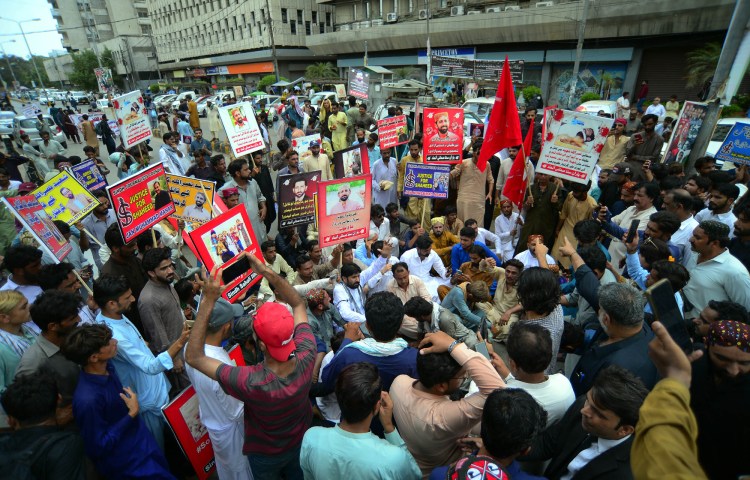
Hayatullah Khan

38 results arranged by date

Six years after the murder of journalist Hayatullah Khan, his brother Ahsan Ahmad Khan has asked CPJ to put pressure on the government and the Supreme Court of Pakistan to ensure that a special investigation carried out in September 2006 into the journalist's death be released. (A copy of Ahsan Ahmad's message can be found here, and CPJ's translation from Urdu is below.)

Unfortunately, we have been down this road before. CPJ has met with officials in the governments of Presidents Pervez Musharraf and Asif Ali Zardari, but none have followed through on their promises to make the results of the investigation known. CPJ joins with Hayatullah Khan's family in their renewed call for the release of Justice Mohammed Reza Khan's September 2006 investigation into his death. After a phone call with Ahsan Ahmad, we sent a letter to President Asif Ali Zardari and Interior Minister Rehman Malik today.

December 6, 2011

President Asif Ali Zardari
Islamic Republic of Pakistan
President House
Islamabad, Pakistan

Dear President Zardari:

This week marks the six-year anniversary of the abduction of journalist Hayatullah Khan. We join his family in asking your government to release the report on the investigation into his death that was prepared by High Court Justice Mohammed Reza Khan in September 2006 under the orders of former President Pervez Musharraf.

It's a coincidence, but May 29, the date of Saleem Shahzad's kidnapping in Pakistan, coincides with the killing of journalist Munir Sangi six years ago. Against all odds, Sangi's widow, Yasmeen Sangi, is still fighting for justice in the case of her late husband, while Shahzad's widow, Anita Saleem--who is now responsible for the couple's three children--has decided not to appear publicly yet. Either way, fighting outright or suffering in silence, slain journalists' families pay a price that lasts a lifetime

AFP

An important distinction is emerging in the murder of Saleem Shahzad, at left, as details of a second post-mortem were released Thursday. Shahzad was not tortured as has been widely reported. He was more likely beaten to death fairly quickly, apparently with iron rods, according to media reports. Here's the highly respected Amir Mir, writing in Asia Times Online, the site that published Shahzad's article that appears to have led to his death:

CPJ challenges authorities in 10 nations
to bring justice and reverse culture of impunity

Protesters in Manila seek justice in the Maguindanao massacre. (Reuters/Romeo Ranoco) New York, April 29, 2010—In the Philippines, political clan members slaughter more than 30 news media workers and dump their bodies in mass graves. In Sri Lanka, a prominent editor who has criticized authorities is so sure of retaliation that he predicts his own murder. In Pakistan, a reporter who embarrassed the government is abducted and slain. In these and hundreds of other journalist killings worldwide, no one has been convicted.

The fighting along the border in Pakistan is a classic counter-insurgency: a large military force trying to oust an entrenched group from its base. Such armed conflict will always be risk-filled—especially for local journalists—but government leaders, military officials, and media executives can take basic steps to improve security.

Local reporters finally confirmed that Taliban leader Baitullah Mehsud was killed in this missile strike. (AP)

Local reporters like those in Federally Administered Tribal Areas, Swat, and Mingora are crucial to accurate, fully formed news coverage. Their importance was evident in August, when reports began to emerge that prominent Taliban leader Baitullah Mehsud had been killed by a U.S.-launched missile apparently fired from an unmanned drone over South Waziristan in the Federally Administered Tribal Areas, or FATA. As Reuters noted in the middle of the dispute, “independent verification of the claims and counter-claims is extremely difficult as the Mehsud lands where the U.S. missile struck the house of Baitullah’s father-in-law are remote and inaccessible.” It was up to local reporters to get the information firsthand. Eventually they did, confirming Baitullah Mehsud’s death. 

Pakistani soldiers in Mingora. (AFP) During the height of the Pakistani military’s assault on militants, hundreds of local journalists were forced to flee the Swat Valley and neighboring areas. Coverage of the fighting was left in large part to Pakistani reporters from outside the region who had embedded with the military. These journalists faced their own set of challenges.
Fighting displaced hundreds of thousands, including these people at a makeshift camp in Swabi. (AFP) Yesterday, I reported on the plight of Behroz Khan and Rahman Bunairee, two Pakistani journalists whose homes were destroyed by militants. Many other journalists in the North West Frontier Province, or NWFP, faced grave dangers and were forced to flee, undermining independent reporting in the region. The same early July night that Khan and Bunairee’s homes were destroyed, Pakistani officials claimed a clear-cut military victory and encouraged the refugees who fled the fighting—relief agencies put the number at 2 million or more—to start returning home.
A Pakistani soldier amid the rubble of Mingora. (AFP) The September 30 Daily Times in Pakistan headlined a story “Peace being gradually restored in Swat,” although daily skirmishes continue between the military and militants. A few days earlier, a massive car bomb in the heart of Peshawar killed at least 10 people and left some 70 wounded, while an explosion destroyed a police station in Bannu. Qari Hussain Mehsud, a Taliban commander in North Waziristan told The Associated Press that his organization had become only stronger after leader Baitullah Mehsud had been killed in a missile strike, most likely fired from a U.S. drone. Clearly, the government offensive that started in April to reclaim the Swat Valley and surrounding areas from militant groups has not marked the end of conflict. Journalists, many of them local reporters who are in the middle of this fighting, will continue to face extraordinary risks and difficulties.

38 results

1 2 3 4 Next Page »