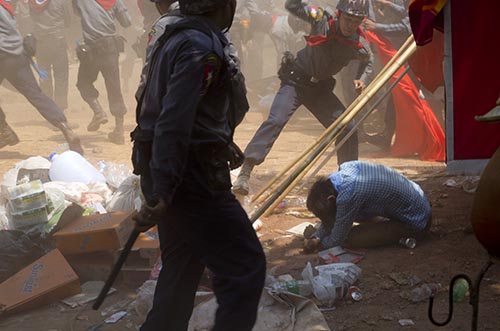
Journalists assaulted, detained in Myanmar crackdown
Bangkok, March 12, 2015–Journalists covering a security force clampdown on a student protest in central Myanmar on Tuesday were harassed, attacked, and detained by police, according to news reports. The Committee to Protect Journalists condemns the assault on and detention of journalists and calls for the immediate and unconditional release of all reporters in police…
As censorship wanes, cyberattacks rise in Burma
Cyberattacks on news websites and apparent government hacking into journalists’ email accounts have raised new questions about the integrity of media reforms in Burma. The New York Times reported on Sunday that several journalists who regularly cover Burma-related news recently received warning messages from Google that their email accounts may have been hacked by “state-sponsored…

Burmese government allows dailies to resume publishing
New York, December 28, 2012–Burmese authorities’ decision to allow private daily newspapers to resume publication is a welcome change to a policy that has stifled press freedom in the country for decades, the Committee to Protect Journalists said today.
Burmese exile news site endures hacking, DDoS attacks
Like other Burmese exile-run media, the Irrawaddy has been plagued by numerous denial-of-service (DDoS) attacks in recent years that have forced its website to be shut down. Now, Aung Zaw, the publication’s founder and editor, believes Burma’s military-backed regime has adopted a new cyber-attack strategy that aims to undermine the exile media’s credibility among readers.
Attacks on the Press 2010: Internet Analysis
Exposing the Internet’s shadowy assailants by Danny O’Brien For the past decade, those who used the Internet to report the news might have assumed that the technological edge was in their favor. But online journalists now face more than just the standard risks to those working in dangerous conditions. They find themselves victims of new…
Burma’s exile media hit by cyber-attacks
Bangkok, September 27, 2010–The Committee to Protect Journalists is gravely concerned by cyber-attacks against three exile-run Burma news outlets, Irrawaddy, Mizzima News, and the Democratic Voice of Burma (DVB). The distributed denial of service (DDoS) attacks have shut Irrawaddy’s main website while temporarily blocking access to Mizzima’s site.