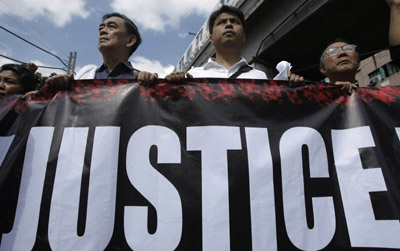
Mobilized and clad in black, a group of Philippine journalists symbolically laid down their notebooks, microphones, and cameras in the street to observe a moment of silence outside Malacañang Palace, the seat of national government in the Philippines.
The gesture was part of a wider protest on Wednesday calling upon President Gloria Macapagal-Arroyo to ensure justice for the victims of the Maguindanao massacre, in which at least 30 journalists and support staff were among the 57 people brutally killed in a premeditated attack outside of Ampatuan on the southern island of Mindanao.
The march and rally in Manila was one of many held around the world in front of Philippine embassies and government offices in a global day of action against what has been characterized as the single largest attack against working journalists ever recorded. A number of suspects linked to the area’s ruling Ampatuan clan, including Andal Ampatuan Jr, the mayor of Dato Unsay town, have been arrested and charged for the premeditated mass murder.
CPJ participated in a recently concluded joint mission led by the National Union of Journalists of the Philippines (NUJP) and the International Federation of Journalists (IFJ) to express solidarity with our Philippine journalist colleagues and join the call on President Gloria Macapagal-Arroyo’s government to take decisive action to ensure a swift and transparent trial and end the culture of impunity in media killings across the country.
The multi-group delegation—including the Southeast Asian Press Alliance, the Indonesian Alliance of Independent Journalists, International Media Support, the Thai Journalists’ Association and others—traveled to Mindanao’s General Santos City to meet with local journalists, the relatives of victims, and local prosecutors responsible for building a case against the suspects.
Our meeting with the slain journalists’ family members put faces to the massacre’s death toll. Many spouses feared for their children’s future and that the politically powerful suspects would evade justice—as has happened with so many previous media killings in Mindanao. Others expressed frustration about their inability to secure the death certificates they required to file murder charges on behalf of their killed loved ones.
An assembly of local journalists situated in the towns near the site of the massacre underlined the trauma felt by many survivors. When we spoke with them, some noted that the security protocols they implemented for reporting in dangerous areas—including traveling in numbers to mitigate risks and asking relevant authorities ahead of dangerous assignments to provide security—had failed to save their friends and colleagues.
Many more feared for their safety in reporting on the massacre’s aftermath, explaining why several reports on the massacre have run without bylines or datelines in both national and local newspapers. One reporter told the assembly that unidentified men had photographed journalists when they reported on the arrests of Ampatuan clan members and the military’s discovery of their underground private armory.
Meanwhile a local prosecutor tasked with building the case against the accused lamented the lack of coordination between his panel and the police officials who had gathered evidence. He also expressed concerns that his team was already severely under-resourced and uneasy about its own security. Even before the Maguindanao massacre, it was common for public prosecutors pursuing media killing cases in Mindanao to travel with armed bodyguards.
Just as worrying are the preliminary indications that evidence from the crime scene may have been contaminated by the military’s use of backhoes to extract bodies from the massacre site’s pits. It’s unclear if those operations were an intentional official attempt to undermine the case against the politically powerful accused or rather the unintentional mishandling by officials inexperienced in dealing with such a huge and complicated crime scene.
Late today, the Philippines daily Inquirer reported that a convoy carrying evidence from the massacre was ambushed as it headed for General Santos City.
There is legitimate cause for concern that the case will never be fully prosecuted. CPJ ranks the Philippines as the sixth worst country in which journalists’ killers are brought to justice, according to our global Impunity Index. The country now falls behind only Iraq in the total number of journalists killed since 1992, our research shows.
The local prosecutor who spoke with the delegation said that there was still plenty of evidence to make murder charges stick, despite the military’s apparently botched handling of the bodies. Presidential Advisor for Mindanao Jesus Dureza told the joint mission that the government had already compiled 70 percent of the evidence it needed to secure convictions, including what he claimed were eyewitnesses who have agreed to testify.
But the politically powerful masterminds behind previous media killings in Mindanao have frequently escaped prosecution and conviction by co-opting, threatening, or even killing witnesses or through the exploitation of legal loopholes in the judicial process. Journalists from the area note that Arroyo and the Ampatuans are known political allies and that the politically powerful clan helped to deliver crucial votes for her at the 2004 general elections Arroyo narrowly won.
That is one reason why the NUJP and other press freedom groups have called on her government to establish a special tribunal situated outside of Maguindanao in a neutral setting to ensure a speedy, secure, and transparent trial. Presidential Press Secretary Cerge Remonde told the joint mission that the government would “not rule out” the creation of such a tribunal to handle the case and that it would welcome international monitoring of the legal proceedings.
The Supreme Court’s recent rulings allowing for changes of venue in a handful of media murder cases from potentially compromised local courts to courts within metropolitan Manila are positive steps toward assuring neutral and secure trials. But achieving justice for the victims’ families in the recent mass murder promises to be a long, complicated, and expensive legal process—one that many here hope will put a legal end to the culture of impunity that culminated tragically in the Maguindanao massacre.
(Reporting from Manila and General Santos City, Philippines)