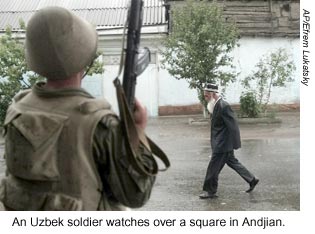
New York, May 16, 2005—Uzbek authorities maintained a virtual blockade today on news coverage of civil unrest in the northeastern city of Andijan, expelling journalists from the town and obstructing foreign television news broadcasts. The Committee to Protect Journalists condemned the moves and called on President Islam Karimov to end the obstruction and harassment of reporters covering the crisis.
Government officials detained journalists working for foreign media outlets and prevented them from reporting on the violent clashes between protesters and security forces that seized Andijan this weekend, according to local and international press reports. Police sealed the city and ordered the journalists out, citing safety concerns.
Reporter Dmitry Yasminov and cameraman Viktor Muzalevsky, of the Russia-based Ren TV, were detained on Saturday as they were trying to enter Andijan to report for the news program, “Nedelya.” They had traveled for several hours from the capital, Tashkent, and had reached the outskirts of the city when they were stopped by local administration officials who confiscated their documents and took them to a police station. “The authorities … decided that we violated the law, filming things without permission,” Yasminov told Ren commentator Marianna Maksimovskaya on Saturday.
The journalists were released after several hours but local administration officials banned them from filming in Andijan. They were escorted back to Tashkent late Saturday, according to local reports.
Early Saturday morning, Uzbek police detained a crew from the Russian television channel NTV at the Andijan outskirts, confiscated their papers, and told them to leave the city. Police officers escorted the crew by car back to Tashkent and returned their identity documents five hours later, NTV reported.
Shamil Baygin, a Reuters correspondent, and Galima Bukharbayeva, a correspondent for the London-based Institute for War and Peace Reporting, were detained by Andijan police late Friday and released Saturday. They left Andijan late Saturday, fearing retaliation by Uzbek security services, the information Web site Fergana.ru reported.
Bukharbayeva reported on Friday that troops in front of the Andijan administration building were shooting indiscriminately at protesting civilians, including women and children. A bullet pierced the backpack Bukharbayeva carried on her back, but she was uninjured, Fergana.ru said.
Today, foreign television channels remained inaccessible in Uzbekistan, authorities blocked the transmission of Russian television news broadcasts, and Uzbek state television broadcast only brief official statements about the situation, without video footage, according to local press and Internet reports.
The Associated Press reported today that the clash between protesters and security forces had so far left as many as 500 people dead in Andijan, and anti-government protests were spreading to nearby cities in Fergana Valley. Television channels have reported few details aside from President Islam Karimov’s version of events, the AP reported.
“The Uzbek people should not have to rely on rumors to get information about the political crisis in Fergana Valley,” CPJ Executive Director Ann Cooper said. “President Karimov’s suppression of news coverage seems designed merely to perpetuate his iron grip on power—but he has an obligation to his citizens to allow the reporting of major events in his country.”
Background on the conflict in Andijan.
