By Bob Dietz
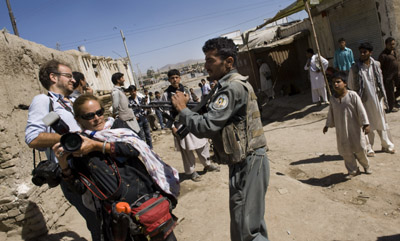
As the United States redeploys forces to Afghanistan, and the Pakistani military moves into the country’s tribal areas, the media face enormous challenges in covering a multifaceted conflict straddling two volatile countries. Pakistani reporters cannot move freely in areas controlled by militants. International reporters in Afghanistan, at risk from kidnappers and suicide bombers, encounter daunting security challenges. And front-line reporters in both countries face pressure from all sides.
ATTACKS ON
THE PRESS: 2009
• Main Index
ASIA
Regional Analysis:
• As fighting surges,
so does danger to press
Maguindanao:
• Makings of a Massacre
Country Summaries
• Afghanistan
• Burma
• China
• Nepal
• North Korea
• Pakistan
• Philippines
• Sri Lanka
• Thailand
• Vietnam
• Other developments
In Pakistan, the dangers have been borne largely by local reporters, many of whom were uprooted from their homes during an escalation in fighting in the North West Frontier Province in mid-year. Three local journalists and one foreign reporter, an Afghan, were killed during the year. Journalists faced bombings, attacks, and threats from the Taliban and other militants, but noted that government and military officials had also exerted political pressure and, at times, a careless disregard for their welfare.
In Afghanistan, where international news media coverage intensified during the year, heightened dangers came in good part from roadside bombs and abductions. One local journalist, Sultan Mohammed Munadi, was killed in 2009, during a British military effort to rescue his fellow captive, New York Times reporter and Irish-British national Stephen Farrell. A Canadian reporter, Michelle Lang, embedded with troops from that country, was killed by a roadside bomb near Kandahar.
Conditions did not deteriorate to the same levels faced by the press in Iraq, where 140 journalists and 51 media support workers were killed and dozens more were abducted, most of them between 2003 and the end of 2008. Yet some parallels exist. As in Iraq, conflict pitted a range of insurgent and criminal groups against well-equipped military forces and weak central governments. Local journalists in Pakistan and Afghanistan provided much of the front-line coverage and were often exposed to great risk, a situation that existed in Iraq.
International news organizations took heightened precautions in the two countries but had not yet established the sort of armed, fortified compounds that housed their operations in Baghdad. International news coverage, particularly in Afghanistan, increased along with the level of fighting. U.S.-based news outlets devoted greater staffing, more airtime, and more print space to the conflict in Afghanistan, making it, by late year, the top news story in the United States for the first time as judged by the Pew Research Center’s Project for Excellence in Journalism.
As in Iraq, increasing risk brought with it greater limitations on access. While Pakistani reporters could embed with the nation’s military to cover the fighting, military rules prevented them from reporting everything they saw. While journalists in Afghanistan could still move relatively freely in Kabul, reporting trips to places such as Kandahar and Kunduz now had to be weighed against the increasing risks there.
The Pakistani government launched two major military offensives in 2009, one into the Swat Valley and surrounding areas beginning in April, and then a push into the heart of the Federally Administered Tribal Areas in October, aimed at the core of the Taliban’s Pakistan-based leadership. In the provincial capital of Peshawar in the midst of the conflict zones, many local reporters from the surrounding towns under attack told CPJ that both the militants and the military had made it more difficult than ever to report independently.
During the Swat Valley offensive, as many as 260 local reporters wound up joining the general population in fleeing the all-out attacks by the Pakistani military, according to the Khyber Union of Journalists. Some stayed behind to take their chances, but their coverage was severely limited by the threat of retaliation. Sher Khan Afridi, president of the Khyber Union of Journalists, said the homes of at least six journalists had been targeted and destroyed by militants angered by news coverage.
One home belonged to Rahman Bunairee, a popular reporter for Khyber TV, a national, privately owned broadcaster, and the U.S. government-funded Voice of America’s Deewa service, which targets the Pashto-speaking audience in the Pakistan-Afghanistan border area. Militants told Bunairee’s family they were retaliating for his reporting. “They had come to destroy our house, and they told us so. They told my father, ‘We have orders to blow up the house because of your son’s criticism of the Taliban,’” Bunairee told CPJ. In the face of continuing threats he fled the country to live in the United States.
Because of the dangers faced by local reporters, much of the coverage was provided by Pakistani journalists from outside the region who embedded with the military. Shamsul Islam Naz, secretary-general of the Pakistan Federal Union of Journalists, told CPJ that the military routinely suppressed stories about the impact of the fighting on the local populace. Other journalists interviewed by CPJ also noted the military’s tight restrictions on embedded reporting.
Muhammad Arshad Sharif, a correspondent for Dawn TV News who embedded with the military during the Swat offensive, acknowledged that some events were not disclosed in news reports from embedded reporters. “For example,” he said, “you can’t show the damage and dead bodies if it’s bad for the military.
“But at least you’re part of history as it is happening, even if you can’t tell the whole story,” added Sharif, who offered hope that “we can show all our footage later, to show the violation of human rights of war.” For Sharif, embedding was a necessary tactic in a situation that offered few attractive options. “Either you cover it from the side of the militants or go over and cover it from the side of the government. Cover it independently and your life is at risk. Your life can be taken away because you could be a target of either of the two sides,” Sharif said.
Between 2001 and 2009, at least 22 journalists were killed in connection to their work in Pakistan, all but two of them local reporters and photographers. Three of the four deaths in 2009 came at the hands of militants, but the Pakistani army also came under criticism for recklessly endangering reporters. In June, troops manning a checkpoint in Malakand fired on AVT Khyber cameraman Malik Imran and the crew’s driver. The journalists said their car was hit after it had cleared the checkpoint. The army never issued a statement or clarification, but an angered Pakistan Federal Union of Journalists did, saying that “such incidents have become the order of the day in conflict areas.” When CPJ met with reporters in July, they complained of persistent harassment from the military once the regular army launched operations within the North West Frontier Province.
Journalists in foreign news bureaus said they were taking more precautions. “We are certainly more security conscious than ever,” said Carol Grisanti, lead producer in Islamabad for the U.S. television network NBC. “New York has to sign off on any trips outside of Islamabad and weigh the safety risks before going to cover the story.” As of late year, Grisanti said, NBC had not seen the need to hire a private security firm as many organizations did in Iraq.
“We definitely rely more on our local crew to go it alone inside the North West Frontier Province,” said Grisanti, who said she and other NBC staffers had once accompanied local reporters on such trips. With NBC’s foreign desk in New York worried about the local staff’s safety, she said, “I need to run all trips by them for safety concerns and then get their approval.”
Those concerns were underscored in December when a suicide bomber set off an explosive device as he tried to enter the grounds of the Peshawar Press Club. Four people were killed—including a police constable who had stopped the bomber at the gate—while 26 were injured. About 30 journalists were inside the club for a press conference.
Gen. David Petraeus, commander of U.S. Central Command, reported in September a 60 percent increase in violence in Afghanistan over the prior year, although he told the Infantry Warfighting Conference that it was “a heck of a lot less than the height of violence in Iraq.” Attacks in the capital, Kabul, were rare before 2008, but since that time a dozen major assaults were reported in the city, including attacks by a range of militant groups on the German Embassy, the headquarters for the NATO-led force, the Information Ministry and the Justice Ministry buildings, as well as other targets near the U.S. Embassy, presidential palace, and airport.
In late year, more than 71,000 NATO troops making up the International Security Assistance Force (ISAF) were going up against a wide array of militant groups including hard-line Taliban and Al-Qaeda fighters, criminal gangs, and drug traffickers, all operating in a country without a strong central government—in many ways a scenario reminiscent of Iraq.
Robert Reid, a veteran Associated Press journalist who has served as bureau chief in Kabul and Baghdad, told CPJ in October that “we don’t hear the hourly explosions or the heavy nighttime bursts of gunfire that were fixtures of life in Baghdad for years. Nor do we have to contend with the hard divisions in the city that we used to face in Beirut in the 1980s.” The capital was getting tougher, he said, but “Westerners can still move about in most of Kabul as long as they maintain a situational awareness and avoid certain areas of the city, especially at night.”
Coverage decisions outside the capital, however, were riskier. “There are wide areas of the country that are no-go areas. I wouldn’t send a Westerner by car to Kandahar, like we were able to do in 2002, nor to Kunduz, Kunar, Paktia, and Paktika. We don’t make any trips outside of Kabul without checking first with the Afghan police, the U.N., ISAF, and some of the security companies. All of that does require greater use of Afghan journalists than a few years ago,” Reid said.
In interviews with journalists stationed in other foreign news bureaus in Kabul, it was clear that all had taken heightened security precautions, though not to the same extent as was done in Iraq. One U.S. journalist, who did not want to be named because the person did not want to appear critical of an employer, said Kabul would not resemble Baghdad in part because news budgets were tight. “Of course we’re more security conscious, we have to be,” the journalist said. “But we’re also under pressure to keep costs down. If things get worse, I don’t know what the plan will be: More security, or less coverage? Maybe both?”
International journalists reflect an unusually high proportion of media fatalities in Afghanistan, according to CPJ research. Eleven of the 17 journalists killed in Afghanistan between 2001 and 2009 were foreign reporters and photographers. That’s far above the worldwide proportion: CPJ data show that about 15 percent of journalists killed in any given country are international reporters. Casualties from militants’ increasing use of roadside bombs underlined the risk. The death of the Canadian journalist Lang in late December followed several other cases in which roadside bombs injured media workers. CBS reporter Cami McCormick was wounded while embedded with U.S. troops in August; a similar strike, also in August, injured Associated Press cameraman Emilio Morenatti and photographer Andi Jatmiko.
A string of abductions also seemed to highlight the risk to Western reporters. The captives included La Repubblica’s Daniele Mastrogiacomo in 2007; the CBC’s Mellissa Fung, Dutch writer Joanie de Rijke, British journalist Sean Langan, and New York Times reporter David Rohde in 2008; and the Times’ Farrell and two unidentified French TV journalists in 2009. All but the French reporters escaped or gained their release, but observers also saw in these cases the grave risks to local reporters: Mastrogiacomo’s fixer, local reporter Ajmal Naqshbandi, and driver, Sayed Agha, were beheaded by their Taliban captors. Farrell’s reporting companion, Munadi, was killed during the British military rescue under circumstances that were not explained. CPJ called on British Prime Minister Gordon Brown to investigate whether Munadi’s rescue was a central objective of the mission, and whether troops had sufficient information to identify him as a captive.
In the southern province of Kandahar, several local journalists told CPJ they had received repeated threats from officials connected with the provincial council headed by Ahmed Wali Karzai, brother and election campaign manager of President Hamid Karzai. News outlets that carried allegations of Ahmed Wali Karzai’s involvement in drug smuggling and campaign corruption were among those targeted, local journalists said. Mirwais Afghan, a former BBC and Reuters journalist, told CPJ he had been forced to flee after receiving direct threats from high-ranking officials.
Jahid Mohseni, chief executive of the Moby Group, which runs an array of media operations, said reporters who pursued hard-nosed local stories about corruption were very vulnerable. “The only things protecting them are their fame and their name in terms of the general public,” Mohseni told CPJ. Their safety, he said, had become a constantly growing concern for management.
Moby’s flagship operation is Tolo TV, which operates in Kabul out of a compound surrounded by walls topped with barbed wire and overseen by armed security guards. With car bombs a growing reality in the city, only the company’s vehicles are permitted within the station’s perimeter—visitors must walk the final block to the bunkered guard house where their IDs are checked. But the station cannot provide around-the-clock security for its reporters. “It’s a tough environment. There are personal security issues—all the reporters we have live on their own,” Mohseni told CPJ.
Another top Afghan journalist, Danish Karokhel, director and editor-in-chief of Pajhwok Afghan News, said security had deteriorated since the beginning of 2008. He noted the station had lost two reporters in two years: Abdul Samad Rohani, who died in 2008, and Janullah Hashimzada, killed across the border in Pakistan in 2009. Some of his reporters had resigned in the face of threats, and Pajhwok started shifting reporters among bureaus whenever threats against any one of them got serious. The agency had tried to support a small insurance fund, while still spending money on flak jackets and other protective equipment.
The matter is made worse for journalists because “the government does not respect the rule of law and freedom of speech,” said Karokhel, a 2008 CPJ International Press Freedom Awardee. The government’s attitude toward media was clear during the run-up to August’s presidential elections, considered corrupt by the United Nations, when security forces obstructed, assaulted, and detained Afghan and foreign journalists around the country. They were enforcing an official gag order on news of violent incidents during the election. A presidential spokesman told the press that information about attacks would discourage voter turnout.
Open-ended detentions of local journalists by U.S. forces have also raised concern, although the practice has been far less prevalent in Afghanistan than it had been in Iraq. CPJ research shows dozens of local journalists were detained by U.S. troops in Iraq without charge. In at least 13 cases, journalists were held for prolonged periods in Iraq (one of which remained pending in late 2009). No charges have been substantiated in any of the cases.
In Afghanistan, there have been several cases of short-term detentions since the U.S.-led retaliation against Al-Qaeda after the September 11, 2001, terror attacks in New York and Washington. But many Afghan journalists saw the 11-month jailing of CBC journalist Jawed Ahmad in 2007 and 2008 as an example of what can happen to a local journalist who winds up under suspicion of Western forces. Ahmad was eventually released without charge, only to be shot to death in Kandahar in March 2009 under unclear circumstances.
With an increase of 30,000 U.S. troops and possible other troop increases in Afghanistan, local journalists told CPJ they were concerned about security conditions. Though the U.S. military does not want to be seen as an occupying force, one Afghan journalist with a major Western news agency was skeptical of its presence. Even though his international media employer is well-known to the military, “I stay away from any of the ISAF troops. It is just too dangerous to be around them if you are not embedded with them—if they don’t know who you are,” he told CPJ. He asked not to be identified because his employer does not allow him to speak publicly about his work.
Covering war is a dangerous occupation and reporters usually understand the risk. Still, media companies and governments can take steps to reduce the danger, if only slightly. Safety training and protective gear for local journalists should be supplied by their employers. Some of those journalists lucky enough to work for large organizations do get such equipment, but the vast majority of local reporters and photographers must fend for themselves.
There is another approach to dealing with the problem. The militaries involved in the conflicts—and there are at least 44 if you include the ISAF’s 42 constituent forces, along with Afghan and Pakistani forces—can begin by including in their preparations specific rules on how troops should conduct themselves when they encounter journalists in the field.
Such training does make a difference. As an example, revised rules for U.S. troops staffing checkpoints in Iraq reduced the number of cases in which innocent people were fired on. U.S. commanders, who wield great influence within the ISAF, should consult with local journalists’ organizations to develop guidelines for new rules of conduct for the interaction between troops and journalists. Those rules should be included in the next edition of the U.S. military’s Counterinsurgency Field Manual and put into practice by all ISAF forces.
Pakistani authorities should ease the restrictions placed on reporters embedded with the military. Suppressing footage or reporting, even if they put the military in a negative light, is counterproductive. Clear, written rules of reporting, agreed upon by both sides, can both protect military security and ensure fair and thorough news coverage. The Pakistani military, while making some strides toward better media relations, has remained less accessible than it should be. In Peshawar, non-embedded journalists told CPJ they had little or no access to military commanders. Taliban militants, on the other hand, maintained an around-the-clock network of spokesmen.
From the guerrilla wars of past decades to the fighting in Afghanistan and Pakistan, counterinsurgency conflict has become the most common form of warfare. The mistakes made in the past—particularly in Iraq, where so many journalists died or were jailed without basis—do not have to be repeated in Afghanistan and Pakistan. Violence is escalating throughout the theater, but there are steps that can be taken to minimize the threat to the men and women reporting from this deadly arena.
Bob Dietz is CPJ’s Asia program coordinator. He reported from Peshawar, Islamabad, and Kabul during 2009.